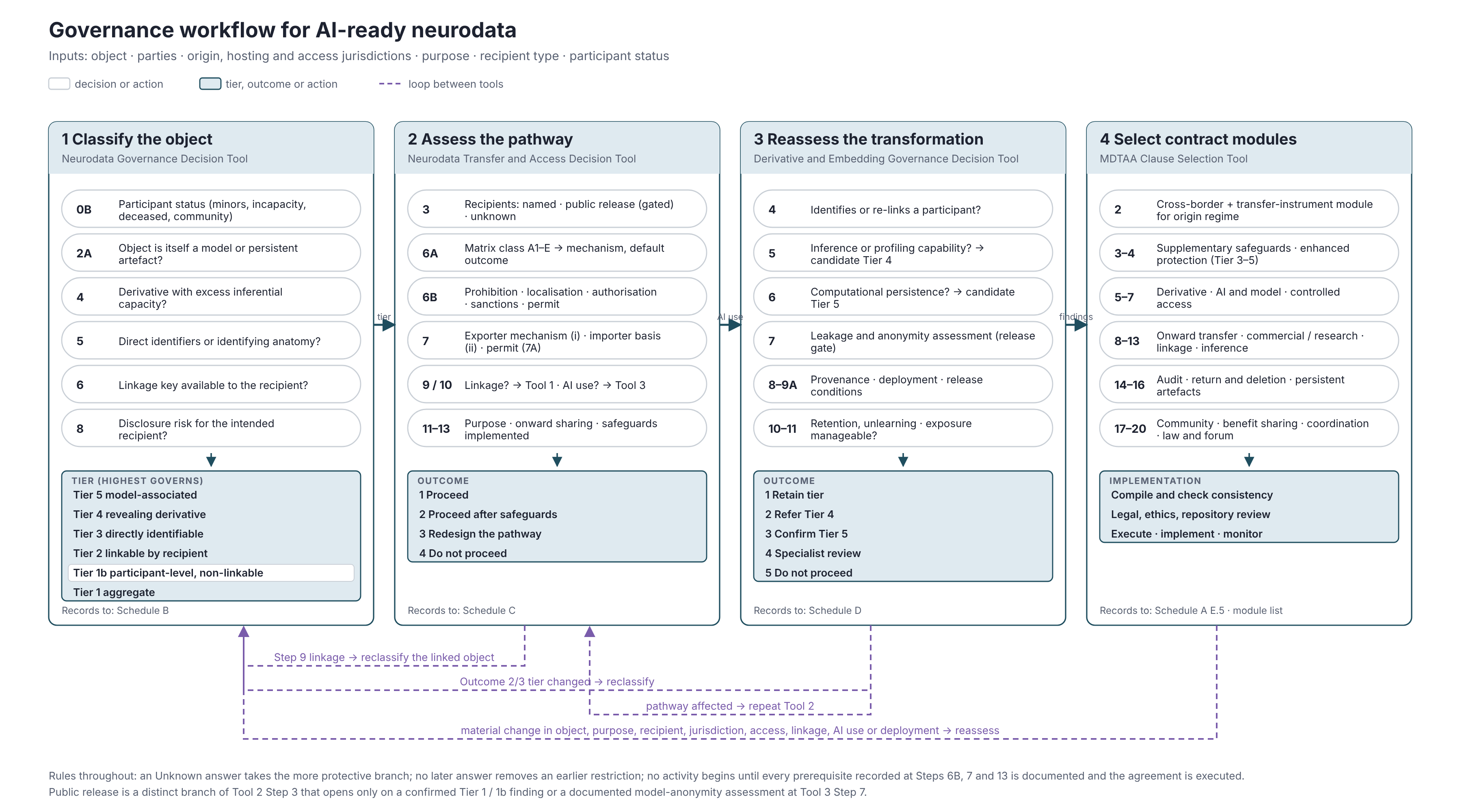
Four tools that take a collaboration from “what are these data?” to the clauses its agreement needs.
1 · Classify
What can the data reveal or enable, for this recipient? Tool 1 assigns a tier by functional exposure.
2 · Test the pathway
Can the proposed transfer or access carry the safeguards that tier requires, under the law at both ends? Tool 2 decides: proceed, proceed with conditions, redesign, or do not proceed.
3 · Reassess derivatives and models
Features, embeddings, synthetic data and model weights are reassessed before release. Tool 3 applies the anonymity test as the gate.
4 · Select the clauses
Tool 4 maps the results to the modules of the Modular Neurodata Transfer and Access Agreement (MDTAA).
Open the tools See the workflow Sixteen worked examples
Built from the law of 93 countries in Africa, Europe, and Latin America and the Caribbean. The tools structure the questions and record the answers. They do not establish that a transfer is lawful, and they do not replace ethics, repository, institutional or legal review.
Tiered Neurodata Risk Classification Framework based on functional exposure
Classifying neurodata by the capacity to enable inference, reconstruction, profiling or harm.
Download tier figure (PNG) Download tier figure (PDF)
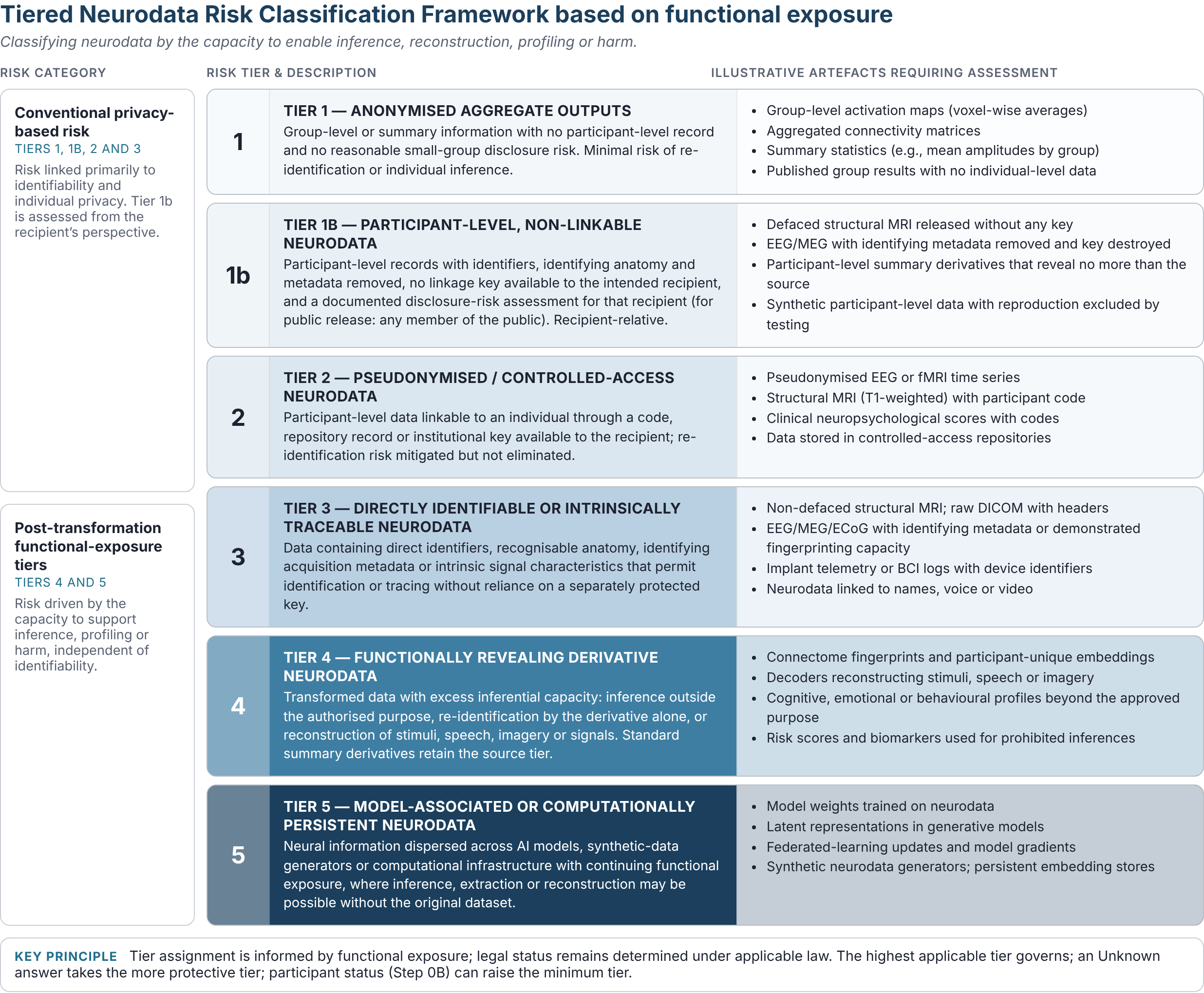
Risk linked primarily to identifiability and individual privacy. Tier 1b is assessed from the recipient’s perspective.
Risk driven by the capacity to support inference, profiling or harm, independent of identifiability.
- Group-level activation maps (voxel-wise averages)
- Aggregated connectivity matrices
- Summary statistics (e.g., mean amplitudes by group)
- Published group results with no individual-level data
- Defaced structural MRI released without any key
- EEG/MEG with identifying metadata removed and key destroyed
- Participant-level summary derivatives that reveal no more than the source
- Synthetic participant-level data with reproduction excluded by testing
- Pseudonymised EEG or fMRI time series
- Structural MRI (T1-weighted) with participant code
- Clinical neuropsychological scores with codes
- Data stored in controlled-access repositories
- Non-defaced structural MRI; raw DICOM with headers
- EEG/MEG/ECoG with identifying metadata or demonstrated fingerprinting capacity
- Implant telemetry or BCI logs with device identifiers
- Neurodata linked to names, voice or video
- Connectome fingerprints and participant-unique embeddings
- Decoders reconstructing stimuli, speech or imagery
- Cognitive, emotional or behavioural profiles beyond the approved purpose
- Risk scores and biomarkers used for prohibited inferences
- Model weights trained on neurodata
- Latent representations in generative models
- Federated-learning updates and model gradients
- Synthetic neurodata generators; persistent embedding stores
The four tools
Each tool is a sequence of questions. Click a step to expand its answer rows and required actions; the search box filters steps by text.
Downloads
Print-ready PDFs (A4 landscape) of the four tools, the workflow figure and the tier framework.
Assigns a functional-exposure tier (5, 4, 3, 2, 1b, 1) to the specific object for the specific recipient. Highest tier governs; Unknown resolves upward; Step 0B can raise the minimum tier.
Tool 1 — Neurodata Governance Decision Tool
Applicability checkpointWhich statutory access regimes and ex ante data-protection, privacy-impact or privacy-risk assessment requirements may apply to the proposed activity? Consider the data category, holder, purpose, jurisdiction and application date, including EHDS where relevant. Assess legal applicability separately from functional-exposure tier.
| Answer | Risk tier | Required action |
|---|---|---|
| Complete checkpoint | No tier is assigned at this step. Follow the instructions in the Required action column. Any tier identified at an earlier step remains applicable unless resolved through documented reassessment. | Record potentially applicable regimes and assessment requirements in Neurodata Governance Assessment Record (Schedule B of the MDTAA) Record any unresolved applicability question and refer it to the responsible legal or institutional reviewer in Neurodata Governance Assessment Record (Schedule B of the MDTAA) Continue to Step 1. Completion of this checkpoint does not resolve or waive an outstanding legal requirement. |
0BParticipant status. Do the neurodata relate, in whole or in part, to (a) minors; (b) adults who lacked capacity to consent at collection; (c) deceased persons; (d) members of an Indigenous people or a community-governed or otherwise defined population with recognised governance interests; or (e) persons in a dependent relationship with the collecting institution (patients, employees, students, detainees)?
| Answer | Risk tier | Required action |
|---|---|---|
| Yes (select all that apply) | No tier is assigned at this step. Follow the instructions in the Required action column. Any tier identified at an earlier step remains applicable unless resolved through documented reassessment. | Record each applicable status and the consent, assent, proxy-consent, community-approval or post-mortem rule relied on under Applicable Law in the Neurodata Governance Assessment Record (Schedule B of the MDTAA). Treat the minimum tier available at the Final Decision as one tier higher than otherwise determined (Tier 1 → Tier 1b; Tier 1b → Tier 2), unless a documented ethics or community determination permits otherwise. Where (d) applies, mark Tool 4 (Supplementary Table 9) Step 17 as required. Continue to Step 1. |
| No | No tier is assigned at this step. Follow the instructions in the Required action column. Any tier identified at an earlier step remains applicable unless resolved through documented reassessment. | Record the basis for the answer in Neurodata Governance Assessment Record (Schedule B of the MDTAA). Continue to Step 1. |
| Unknown | No tier is assigned at this step. Follow the instructions in the Required action column. Any tier identified at an earlier step remains applicable unless resolved through documented reassessment. | Record the uncertainty; obtain the information from the Principal Investigator or data steward. Apply the ‘Yes’ action provisionally. Continue to Step 1. |
1Does this object contain, represent or derive from human neurodata? ? Examples include MRI, fMRI, EEG, MEG, ECoG, neural implant data, BCI recordings, neural features, embeddings, predictions, or AI models trained using neurodata.
| Answer | Risk tier | Required action |
|---|---|---|
| No | No tier is assigned at this step. Follow the instructions in the Required action column. Any tier identified at an earlier step remains applicable unless resolved through documented reassessment. | Record why the object falls outside this Tool’s scope in Neurodata Governance Assessment Record (Schedule B of the MDTAA). Record the outcome as “Not applicable” in Neurodata Governance Assessment Record (Schedule B of the MDTAA). Follow the institution’s ordinary data-governance procedures. End this Tool. |
| Yes | No tier is assigned at this step. Follow the instructions in the Required action column. Any tier identified at an earlier step remains applicable unless resolved through documented reassessment. | Record the object’s human-neurodata source or relationship in Neurodata Governance Assessment Record (Schedule B of the MDTAA). Continue to Step 2A. |
| Unsure | No tier is assigned at this step. Follow the instructions in the Required action column. Any tier identified at an earlier step remains applicable unless resolved through documented reassessment. | Record the uncertainty in Neurodata Governance Assessment Record (Schedule B of the MDTAA) Obtain clarification from the Principal Investigator, data steward or technical lead before beginning the proposed sharing or analysis. Pause this assessment. Return to Step 1 when the evidence supports “Yes” or “No”. |
2AIs the object under assessment itself a trained AI model, model component, model gradient, shared embedding store, synthetic-data generator, federated-learning artefact or other persistent computational artefact that was trained on, fitted to or otherwise derived from human neurodata? Examples include model weights, foundation models, federated-learning systems, synthetic-data generators, model gradients, or shared embedding repositories.
| Answer | Risk tier | Required action |
|---|---|---|
| Yes | No tier is assigned at this step. Follow the instructions in the Required action column. Any tier identified at an earlier step remains applicable unless resolved through documented reassessment. | Record the artefact, its version and the form of incorporation in Neurodata Governance Assessment Record (Schedule B of the MDTAA). Mark Tool 3 (Supplementary Table 8) as required for this object. Continue to Step 2B. |
| No | No tier is assigned at this step. Follow the instructions in the Required action column. Any tier identified at an earlier step remains applicable unless resolved through documented reassessment. | Record the basis for this answer in Neurodata Governance Assessment Record (Schedule B of the MDTAA). If a model has been or will be trained on this object, note that the model is a separate object requiring its own Tool 1 and Tool 3 assessment. Continue to Step 3. |
| Unknown | Tier 5 | Record provisional Tier 5 in Neurodata Governance Assessment Record (Schedule B of the MDTAA) and apply the Tier 5 safeguards specified in Annexure 1 §3.5 to the relevant object and activity. Request technical confirmation of whether incorporation has occurred. Continue to Step 3 to identify additional exposure and safeguards. When clarification is available, return to Step 2A: if “Yes”, continue to Step 2B; if “No”, document resolution of this provisional finding and continue to Step 3. Do not finalise a lower tier or proceed with affected sharing, transfer or deployment while this uncertainty remains unresolved. |
2BIs there evidence, or a reasonable possibility, that neural information persists within the model or computational infrastructure in a manner capable of supporting identification, inference, reconstruction, extraction or profiling of individuals or groups? Consider model memorisation, inversion, membership inference, extraction attacks, reconstructive outputs, shared embeddings and other forms of persistent representation.
| Answer | Risk tier | Required action |
|---|---|---|
| Yes | Tier 5 | Record a provisional Tier 5 condition in Neurodata Governance Assessment Record (Schedule B of the MDTAA) and apply Tier 5 safeguards provisionally under Annexure 1 §3.5. Record the evidence or credible technical assessment supporting continuing functional exposure in Neurodata Governance Assessment Record (Schedule B of the MDTAA). Initiate or complete Tool 3 (Supplementary Table 8) and apply the Tool 3 (Supplementary Table 8) return procedure below. Continue to Step 3 to identify additional exposure and safeguards. Tier 5 remains unconfirmed until the required assessment establishes its criteria |
| No | No tier is assigned at this step. Follow the instructions in the Required action column. Any tier identified at an earlier step remains applicable unless resolved through documented reassessment. | Record the supporting technical assessment in Neurodata Governance Assessment Record (Schedule B of the MDTAA). Complete Tool 3 (Supplementary Table 8) because Step 2A was answered “Yes”; this answer does not remove that requirement. Apply the Tool 3 (Supplementary Table 8) return procedure below. Continue to Step 3. Do not remove an existing higher-tier finding solely on the basis of this answer. |
| Unknown | Tier 5 | Record provisional Tier 5 in Neurodata Governance Assessment Record (Schedule B of the MDTAA) and apply Tier 5 safeguards under Annexure 1 §3.5. Record the unresolved exposure question in Neurodata Governance Assessment Record (Schedule B of the MDTAA). Obtain appropriate specialist technical, legal, ethics or institutional review and complete Tool 3 (Supplementary Table 8). Apply the Tool 3 (Supplementary Table 8) return procedure below. Continue to Step 3 to identify additional exposure and safeguards. Do not finalise a lower tier or proceed with affected sharing, transfer or deployment until the uncertainty is resolved. |
3Is this object a derived neurodata product rather than the original neurodata? ? Examples include embeddings, feature vectors, neural fingerprints, cognitive profiles, classifiers, predictions, or reconstructed neural representations.
| Answer | Risk tier | Required action |
|---|---|---|
| Yes | No tier is assigned at this step. Follow the instructions in the Required action column. Any tier identified at an earlier step remains applicable unless resolved through documented reassessment. | Record the source neurodata and the transformation that produced the object in Neurodata Governance Assessment Record (Schedule B of the MDTAA). Continue to Step 4. |
| No | No tier is assigned at this step. Follow the instructions in the Required action column. Any tier identified at an earlier step remains applicable unless resolved through documented reassessment. | Record the basis for treating the object as original neurodata. in Neurodata Governance Assessment Record (Schedule B of the MDTAA). Continue to Step 5 to assess direct identification and traceability. |
| Unknown | No tier is assigned at this step. Follow the instructions in the Required action column. Any tier identified at an earlier step remains applicable unless resolved through documented reassessment. | Obtain provenance or processing information from the data steward or technical lead. Retain all existing tier findings and safeguards. Pause progression beyond this step. Return to Step 3 when the evidence supports “Yes” or “No”. |
4Does this derived object have excess inferential capacity, that is, can it, alone or with information reasonably available to the intended recipient: (i) support inference about neurological, cognitive, emotional or behavioural states or traits outside the purpose for which the source neurodata were authorised; (ii) identify or trace a participant by itself (for example a functional-connectome fingerprint or a high-dimensional embedding unique to a participant); or (iii) reconstruct stimuli, speech, imagery or neural signals? Standard summary derivatives that reveal no more than the source dataset already reveals (for example regional volumes, connectivity matrices or spectral summaries used for the authorised purpose) do not satisfy this question and retain the source tier. Apply Annexure 1 §4.1.6 and the §2.1 distinction between ordinary aggregate description and material group-level Functional Exposure.
| Answer | Risk tier | Required action |
|---|---|---|
| Yes | Tier 4 | Record a Tier 4 finding and the relevant capability in Neurodata Governance Assessment Record (Schedule B of the MDTAA). Restrict access to controlled access; document permitted uses and prohibited inferences inNeurodata Governance Assessment Record (Schedule B of the MDTAA); prohibit unauthorised profiling, reconstruction and general-purpose AI training; and maintain provenance records. Obtain specialist governance review and complete Tool 3 (Supplementary Table 8). Complete Neuro-TADT (Tool 2) (Supplementary Table 7) before external sharing or international transfer. Retain any higher tier finding. Continue to Step 5. |
| No | No tier is assigned at this step. Follow the instructions in the Required action column. Any tier identified at an earlier step remains applicable unless resolved through documented reassessment. | Record the evidence supporting this answer in Neurodata Governance Assessment Record (Schedule B of the MDTAA), including why the derivative reveals no more than the source dataset and the additional information reasonably available to the intended recipient. Continue to Step 5. |
| Unknown | Tier 4 | Record provisional Tier 4 and the capability requiring assessment in Neurodata Governance Assessment Record (Schedule B of the MDTAA). Apply the safeguards specified in the Step 4 “Yes” row provisionally. Complete Tool 3 (Supplementary Table 8) and obtain the specialist review needed to resolve the uncertainty. Retain any higher tier finding. Continue to Step 5. |
5Does the object contain direct identifiers, recognisable identifying anatomy, identifying acquisition metadata, or intrinsic information that reasonably permits participant identification or tracing beyond linkage through a separately protected code or mapping? Examples include names, identifying DICOM headers, non-defaced facial anatomy, identifying voice or video, or device identifiers and timestamps that enable tracing. Being a raw EEG, MEG, ECoG or MRI acquisition is not, by itself, a “Yes”; linkage solely through a protected code or mapping is assessed at Step 6.
| Answer | Risk tier | Required action |
|---|---|---|
| Yes | Tier 3 | Record a Tier 3 finding and the identifiers or intrinsic traceability identified in Neurodata Governance Assessment Record (Schedule B of the MDTAA). Store the object in a secure controlled environment with encryption, role-based access, audit logs, and formal access approval. Remove unnecessary identifiers where feasible and restrict downloads and onward sharing. Complete Neuro-TADT (Tool 2) (Supplementary Table 7) before international transfer or external access. Retain any higher tier finding. Continue to Step 6. |
| No | No tier is assigned at this step. Follow the instructions in the Required action column. Any tier identified at an earlier step remains applicable unless resolved through documented reassessment. | Record the basis for concluding that the specified identifiers and intrinsic traceability are absent in Neurodata Governance Assessment Record (Schedule B of the MDTAA). Continue to Step 6. |
| Unknown | Tier 3 | Record provisional Tier 3 in Neurodata Governance Assessment Record (Schedule B of the MDTAA). Apply the safeguards specified in the Step 5 “Yes” row provisionally. Assign an identifier and traceability review to the responsible data steward or technical reviewer. Retain any higher tier finding. Continue to Step 6. Return to Step 5 when the review supports “Yes” or “No”. |
6Does the object still contain participant-level neurodata that can be linked back to an individual through a code, repository record or institutional key that is available to, or obtainable by, the intended recipient? Where a key exists but is held by another party under a documented undertaking not to disclose it, answer ‘No’ for that recipient and ‘Yes’ for the key-holder, and record both. Example: a pseudonymised EEG dataset whose participant identifiers are held by the originating institution (‘Yes’ for the originating institution; ‘No’ for an external recipient that has no access to the key).
| Answer | Risk tier | Required action |
|---|---|---|
| Yes | Tier 2 | Record a Tier 2 finding, the linkage mechanism and the responsible custodian in Neurodata Governance Assessment Record (Schedule B of the MDTAA). Use controlled-access repositories; separate and protect the linkage key; encrypt data in storage and transit; maintain access logs; and restrict re-identification and onward sharing. Put any required Data Use or Transfer Agreement in place before the relevant access or transfer. Where another institution holds the key, record its custody and restrictions without obtaining or disclosing the key. Retain any higher tier finding. Proceed to the Final Decision. |
| No | No tier is assigned at this step. Follow the instructions in the Required action column. Any tier identified at an earlier step remains applicable unless resolved through documented reassessment. | Record the evidence that no linkage mechanism is available to the intended recipient (key destroyed; or key-holder identified with its undertaking recorded) in Neurodata Governance Assessment Record (Schedule B of the MDTAA). If a candidate, provisional or confirmed Tier 3, Tier 4 or Tier 5 finding remains active, proceed to the Final Decision. Otherwise, continue to Step 7. |
| Unknown | Tier 2 | Record provisional Tier 2 in Neurodata Governance Assessment Record (Schedule B of the MDTAA). Apply the linkage safeguards specified in the Step 6 “Yes” row to any existing or potentially retained linkage mechanism. Request confirmation from the data holder or repository custodian about whether participant-level linkage remains possible. Retain any higher tier finding. Proceed to the Final Decision with the uncertainty unresolved. When confirmation is available, return to Step 6 and follow the “Yes” or “No” branch. |
7Does the object contain only aggregated or summary-level information with no participant-level records or persistent participant trace? Example: A published study reporting only group-average brain activation patterns, summary statistics, or aggregate connectivity measures with no participant-level records or re-identifiable individual data.
| Answer | Risk tier | Required action |
|---|---|---|
| Yes | No tier is assigned at this step. Follow the instructions in the Required action column. Any tier identified at an earlier step remains applicable unless resolved through documented reassessment. | Record the aggregation or summarisation method and the evidence that no participant-level records or persistent participant trace remain in Neurodata Governance Assessment Record (Schedule B of the MDTAA). Continue to Step 8. |
| No | No tier is assigned at this step. Follow the instructions in the Required action column. Any tier identified at an earlier step remains applicable unless resolved through documented reassessment. | Record that the object contains participant-level records without an available linkage mechanism (candidate Tier 1b) in Neurodata Governance Assessment Record (Schedule B of the MDTAA). Continue to Step 8 for the disclosure-risk assessment. Do not record ‘Unclassified’ at this step. |
| Unknown | No tier is assigned at this step. Follow the instructions in the Required action column. Any tier identified at an earlier step remains applicable unless resolved through documented reassessment. | Record that aggregate-only status has not been established Neurodata Governance Assessment Record (Schedule B of the MDTAA). Request technical review of participant-level records, persistent traces and the aggregation or summarisation method. Pause classification and retain any existing safeguards. Do not approve release through this Tool while the uncertainty remains unresolved. Return to Step 7 when the evidence supports “Yes” or “No”. |
8Could an individual or small group still reasonably be identified by means reasonably likely to be used by the intended recipient (for public release: by any member of the public), through rare conditions, small sample sizes, unique characteristics, intrinsic signal characteristics known to permit re-identification for this modality (for example residual facial features after defacing; connectome fingerprints), accompanying metadata, or linkage with data reasonably available to the recipient? Example: a dataset describing a single participant with a rare neurological disorder, a very small cohort from one clinic, or records containing unique demographic or geographic metadata.
| Answer | Risk tier | Required action |
|---|---|---|
| Yes | Tier 2 (minimum) | Record Tier 2 as the minimum applicable tier and identify the disclosure mechanism in Neurodata Governance Assessment Record (Schedule B of the MDTAA). Increase aggregation, suppress disclosive information or strengthen de-identification where feasible. Determine and record the necessary access restrictions, including controlled access where required. Reassess the modified object before release, repeating Steps 5–8 and any earlier step affected by the modification. Retain any higher tier finding unless documented reassessment resolves it. Proceed to the Final Decision. |
| No — and the object is aggregate-only (Step 7 ‘Yes’) | Tier 1 Note: A Tier 1 outcome does not automatically exclude Annexure 3 in the MDTAA. Apply the exception and triggers in Annexure 1 §7.2 in the MDTAA to the particular object and proposed activity, and record the reason for completing or omitting Annexure 3 in the MDTAA. A Tier 1 outcome shall not override a higher candidate, provisional or confirmed tier identified elsewhere in the assessment. | Record a Tier 1 finding and the supporting disclosure-risk assessment in Neurodata Governance Assessment Record (Schedule B of the MDTAA). Document the aggregation or anonymisation method and confirm that no participant-level record, persistent participant trace or linkage mechanism remains in Neurodata Governance Assessment Record (Schedule B of the MDTAA). Check the triggers and exceptions in Annexure 1 §7.2 and record why Tool 3 (Supplementary Table 8) is required or may be omitted. Do not use this finding to override a higher candidate, provisional or confirmed tier. Proceed to the Final Decision. |
| No — and the object is participant-level (Step 7 ‘No’) | Tier 1b Note: a Tier 1b finding is made for a specified recipient (or for the public) and may differ from the tier applying to the Data Exporter, which may retain a key (Tier 2). A Tier 1b outcome shall not override a higher candidate, provisional or confirmed tier identified elsewhere in the assessment. | Record a Tier 1b finding and the supporting disclosure-risk assessment in Neurodata Governance Assessment Record (Schedule B of the MDTAA). Document the de-identification method (including defacing, header stripping and date shifting, with software and version), the absence of an available linkage mechanism, and the recipient (or ‘public’) for which the finding is made. Select and record the licence or access condition required by Annexure 1 §3.1b(d), including a prohibition on re-identification attempts. Apply any uplift required by Step 0B. Check the triggers and exceptions in Annexure 1 §7.2 and record why Tool 3 (Supplementary Table 8) is required or may be omitted. Do not use this finding to override a higher candidate, provisional or confirmed tier. Proceed to the Final Decision. |
| Unknown | Tier 2 | Record provisional Tier 2 in Neurodata Governance Assessment Record (Schedule B of the MDTAA). Obtain a disclosure-risk review addressing rare conditions, small samples, unique characteristics, and accompanying metadata. Withhold release pending resolution of this uncertainty. Retain any higher tier finding. Proceed to the Final Decision with the uncertainty unresolved. Return to Step 8 when the review supports “Yes” or “No”. |
Final DecisionHave all applicable steps and required classification reviews been completed?
| Answer | Risk tier | Required action |
|---|---|---|
| Complete assessment | - | Record the highest applicable tier and whether it is provisional or confirmed. Do not finalise a lower tier while a higher candidate or provisional finding remains unresolved. Retain all safeguards whose underlying conditions remain present. Save the outcome, supporting evidence, outstanding actions and responsible reviewer in the assessment record; incorporate or reference it in Neurodata Governance Assessment Record (Schedule B of the MDTAA). where applicable. Complete or update Tools 2 (Supplementary Table 7) and 3 (Supplementary Table 8) where required, then proceed to Tool 4 (Supplementary Table 9) where contractual implementation is needed. Do not begin the proposed activity until required safeguards and approvals are in place. Apply any tier uplift recorded at Step 0B before finalising. |
Asks whether the proposed pathway can carry the tier’s safeguards: recipient type (including the gated public-release branch), matrix class (Step 6A), origin- and destination-side restrictions (Step 6B), exporter and importer checks, linkage, AI use, purpose, onward sharing and safeguards. Four outcomes.
Tool 2 — Neurodata Transfer and Access Decision Tool, Neuro-TADT
1What are you planning to do with the neurodata? Example: Using an EEG dataset to train a machine learning model for early detection of Alzheimer's disease.
| Answer | Required action |
|---|---|
| Internal use only with no external or cross border sharing or access to data. | Record the internal use and why no listed external or cross-border pathway applies. Apply the safeguards identified in Supplementary Table 6 and assess applicable statutory access and authorisation requirements. Record “Neuro-TADT not required for this arrangement” and end this Tool. Other applicable governance assessments remain required |
| Share with another institution; international transfer; repository deposit; cloud-hosted access; or AI platform or vendor access. | Record every selected pathway and the proposed activity. Continue to Step 2. |
| Unsure | Obtain clarification of the proposed storage, sharing, access and processing arrangements. Pause the assessment and do not begin the proposed transfer or external access. Return to Step 1 when the pathway is established. |
2Has the neurodata already been assigned a risk tier using (Tool 1) Supplementary Table 6? Example: The neurodata has been classified as Tier 2 (Moderate Risk) using the criteria in Supplementary Table 26 before planning further processing or sharing.
| Answer | Required action |
|---|---|
| Yes | Record the tier, whether it is provisional or confirmed, the applicable safeguards and the (Tool 1) Supplementary Table 6 assessment reference. Carry forward all unresolved conditions and restrictions. A provisional tier may support pathway assessment but does not remove required review. Continue to Step 3. |
| No | Complete (Tool 1) Supplementary Table 6 to get a risk tier assigned to the particular data object and proposed activity. Return to Step 2 after a tier has been assigned. If (Tool 1) Supplementary Table 6 cannot establish a tier and requires specialist review, select Final Decision Outcome 4 below. |
| Unsure | Locate the existing classification and check that it covers the object, version and proposed activity. Complete or update records according to Supplementary Table 6 if the classification is absent or no longer applicable. Return to Step 2 when the tier and safeguards are established. |
3Who will receive or access the neurodata? Example: An approved research collaborator, an international research consortium, or a trusted cloud service provider processing the neurodata under a data processing agreement.
| Answer | Required action |
|---|---|
| Named collaborating institution; repository; cloud provider; commercial partner; or AI developer. Select all that apply. | Record each recipient’s name, role and proposed access or processing activity. Continue to Step 4. |
| Unknown recipients | Record which recipients remain unidentified. Obtain recipient information from the proposed collaborator, repository, provider or other responsible party. Do not begin transfer or access. Return to Step 3 once recipients are identified. If they cannot be identified, select Final Decision Outcome 4 below. |
| Public or unrestricted release (open repository deposit, open licence, public model weights, publication of participant-level supplementary data) | Record the release channel, licence and any registration or click-through conditions. Public release is permitted through this Tool only where (a) Tool 1 (Supplementary Table 6) records a confirmed Tier 1 or Tier 1b finding made for the public as recipient, or (b) for a model or other computational artefact, Tool 3 (Supplementary Table 8) Step 7 records leakage testing with no material exposure for the intended release conditions and a documented anonymity assessment. If neither condition is met, record ‘Public release not supported by current classification’ and either select Final Decision Outcome 3 (redesign: controlled access, gated or registered access, or federated access) or return the object to Tool 1/Tool 3 for further de-identification or testing. If a condition is met, record ‘Recipients: public’ at Steps 4 and 12, treat Step 5 as ‘Downloadable copy’, and continue to Step 6. |
4Can every recipient and subprocessor be identified? Example: All recipients are known by name, including collaborating institutions, cloud service providers, and any contracted subprocessors.
| Answer | Required action |
|---|---|
| Yes | Record each recipient and subprocessor, its role and the information available about its access. Continue to Step 5. |
| No or Unsure | Request a complete recipient and subprocessor list from the responsible organisation or provider. Do not begin transfer or access while required identities remain unresolved. Return to Step 4 when the list is complete. If the required information cannot be established, select Final Decision Outcome 4 below. |
| Not applicable — public release recorded at Step 3 | Record ‘Not applicable: public release permitted under Step 3’. Continue to Step 5. |
5How will recipients access the neurodata or governed artefact? Example: The recipient can download and retain a local copy of the neurodata rather than accessing it only through a secure remote environment.
| Answer | Required action |
|---|---|
| Downloadable copy | Record what may be downloaded, by whom and to which environment. Specify tier-appropriate controls for local storage, copying, access, onward sharing, retention and deletion. Continue to Step 6. |
| Remote or controlled access without downloading the underlying object | Record the access environment, authorised users and restrictions on downloading or exporting data and outputs. Specify access controls, logging and output review appropriate to the tier. Continue to Step 6. |
| Query-only or federated access | Record where processing occurs and what queries, outputs, gradients or other information may leave each environment. Specify controls on queries, outputs, access and logging appropriate to the tier. Continue to Step 6. |
| Unsure | Obtain confirmation of the access modes and export capabilities from the recipient or infrastructure provider. Pause the assessment and do not begin access. Return to Step 5 when the access arrangements are established. |
6Will the neurodata be transferred to, stored in, or remotely accessed from another legal jurisdiction? Example: neurodata remains on a server in South Africa but is accessed remotely by researchers in Germany.
| Answer | Required action |
|---|---|
| Yes | Record every relevant originating, receiving, hosting and remotely accessing jurisdiction, including relevant subprocessor locations. Continue to Step 7. |
| No | Record the locations and the basis for concluding that no cross-jurisdictional transfer, storage or remote access is involved. Continue to Step 7. |
| Unsure | Obtain location and remote-access information from the recipients and infrastructure providers. Do not begin transfer or access while relevant jurisdictions remain unresolved. Return to Step 6 when the locations are established. If they cannot be established, select Final Decision Outcome 4 below. |
6APathway class. What is the compatibility class of the origin→destination pathway (and of each origin→hosting and origin→remote-access pathway) in Supplementary Data 2 (or the current online version of the matrix)? Record the matrix version and date. Where the destination is the United States or Canada, use the North American governance-unit analysis (Supplementary Figure 1) and record the applicable federal, state or provincial regime instead of a class. Example: Nigeria → Germany is Class B; Germany → Brazil was Class C at the study cut-off and is adequacy-based (Class A2) since 26 January 2026.
| Answer | Required action |
|---|---|
| A1 (unified legal space) | Record ‘A1: no transfer mechanism required’. The lawful basis for processing in both environments and any sector-specific or institutional condition remain required at Step 7. Continue to Step 6B. |
| A2 (convergent; adequacy-type recognition) | Record the adequacy decision, regulation or recognition relied on, its date and any scope limits (for example sectoral or organisational limits, as for Canada (commercial organisations) or the United States (DPF-certified organisations only)). Verify that the recipient falls within the scope; if it does not, treat the pathway as Class B. Continue to Step 6B. |
| B (standard transfer instrument) | Record the instrument required by the origin regime (see the Step 6B regime table and the MDTAA Transfer-Instrument Modules). Mark the corresponding MDTAA module for activation at Tool 4 (Supplementary Table 9) Step 2. Continue to Step 6B. |
| C (operationally conditional) | As for Class B, and in addition: mark Tool 4 Step 3 (Supplementary Safeguards Module) as required; require a documented transfer-risk or impact assessment at Step 7(i); and record the supplementary institutional, repository or technical safeguards that make the pathway navigable. Continue to Step 6B. |
| D (restricted in practice) | Record that the pathway is restricted. Default to Final Decision Outcome 3: redesign toward remote access, federated or query-only access, aggregation to Tier 1, or an alternative destination. Proceed with a transfer of participant-level data only where counsel in the origin jurisdiction documents a lawful mechanism and the authorisations required at Step 6B. Continue to Step 6B. |
| E (insufficient legal certainty) | Record that legal certainty is insufficient. Default to Final Decision Outcome 4 unless counsel in the origin jurisdiction documents a lawful mechanism; where that is done, treat the pathway as Class D. Continue to Step 6B. |
| Not in matrix / Unsure | Record the gap. Obtain an origin-jurisdiction legal assessment and treat the pathway as Class C pending that assessment. Continue to Step 6B. |
6BOrigin-side and destination-side restrictions. Using the Step 6B regime table (and Supplementary Data 3 for jurisdictions not listed), does any of the following apply? (a) a statutory prohibition on transferring this category of data or this type of database (e.g., LGPD art. 13 §2); (b) a localisation, serving-copy or in-country processing duty (e.g., Kenya reg. 26; Rwanda art. 50); (c) a requirement of prior authorisation, notification, licence or registration by a regulator before transfer or storage abroad (e.g., POPIA s. 57(1)(d); NCSA authorisation); (d) sanctions, export-control or national-security screening of the destination or recipient (e.g., US DOJ Data Security Program, 28 CFR Part 202; OFAC) where any Party is a US person or the data concern US persons; (e) a research export permit, ethics-committee export clearance or data-transfer approval required by the origin jurisdiction (e.g., NACOSTI; NHREC); (f) a destination-side import condition (registration, local representative, sectoral hosting certification such as HDS in France).
| Answer | Required action |
|---|---|
| Yes (select all that apply) | Record each applicable restriction, the responsible Party, the competent authority and the evidence required. Where (a) applies, select Final Decision Outcome 3 (redesign so that no transfer of the prohibited category occurs, for example analysis within the origin environment with export of results only) or Outcome 4. Where (b)–(f) apply, mark each as a prerequisite: Outcome 1 may not be selected until the authorisation, registration, serving copy, screening or permit is documented; Outcome 2 may be selected where the action is pending. Continue to Step 7(i). |
| No | Record the basis for concluding that none applies, with reference to the regime table or Supplementary Data 3. Continue to Step 7(i). |
| Unsure | Obtain origin-jurisdiction and destination-jurisdiction review. Do not begin transfer or access. Return to Step 6B when established; if it cannot be established, select Final Decision Outcome 4 below. |
7(i)Exporter side. Under the law of the originating jurisdiction, have the following been identified and documented: the lawful basis or justification for the disclosure; the transfer mechanism indicated at Step 6A (or the reason none is required); the transfer-risk, transfer-impact, privacy-impact or data-protection assessment required for that mechanism or by the origin regime; the authorisations identified at Step 6B; the exporter’s authority to make the present transfer or release under any upstream conditions (consent scope, ethics approval, repository or funder terms, community agreements); and the ethics, institutional and repository approvals required? Consider consent or another lawful basis, statutory transfer provisions, adequacy-type mechanisms, contractual safeguards, DPIAs, PIAs or other jurisdiction-specific assessments, regulatory authorisation and institutional approval, as applicable.
| Answer | Required action |
|---|---|
| Yes | Record each item with its reference and status. Verify the Data Exporter’s authority to make the present transfer or release, including applicable upstream conditions. Mark outstanding items as pending. Continue to Step 7(ii). |
| No or Unsure | Identify the missing basis, mechanism, assessment, approval or evidence of authority. Obtain the necessary origin-jurisdiction legal, ethics, institutional or repository review. Do not begin transfer or access. Return to Step 7(i) when documented. If no applicable lawful pathway can be established, select Final Decision Outcome 4 below. |
7(ii)Importer side. Under the law of each receiving, hosting and remotely accessing jurisdiction, have the following been identified and documented: the recipient’s own lawful basis or justification for processing (including any special-category, health-data or sensitive-data condition); any registration, notification, licensing, local-representative or data-protection-officer requirement applying to the recipient; any sectoral hosting requirement (for example health-data hosting certification); and the recipient’s ethics or institutional approval for the proposed use?
| Answer | Required action |
|---|---|
| Yes | Record each item with its reference and status. Continue to Step 7A. |
| No or Unsure | Identify the missing item and obtain destination-jurisdiction review. Do not begin transfer or access. Return to Step 7(ii) when documented; if it cannot be established, select Final Decision Outcome 4 below. |
7ADoes the proposed activity require a statutory access authorisation, data permit or research permit under the origin regime or the hosting regime? Examples: a Findata permit (Finland); a Health Data Hub/CESREES authorisation (France); a Forschungsdatenzentrum authorisation (Germany); a Garante authorisation under art. 110 of the Privacy Code (Italy); a NACOSTI permit (Kenya); a UNCST clearance (Uganda); a COSTECH permit (Tanzania); CONEP approval of an international collaboration (Brazil); or, from 26 March 2029, an EHDS data permit.
| Answer | Required action |
|---|---|
| Yes | Record the competent body, required authorisation, application or approval status, and reference. Record the authorised purpose, users, duration, processing location and release conditions once established. Mark an authorisation not yet obtained as pending; do not begin the activity requiring it. Continue to Step 8. |
| No | Record the basis for concluding that no such authorisation is required for this activity. Continue to Step 8. |
| Uncertain | Obtain review of the authorisation requirement. Do not begin the affected transfer or access. Return to Step 7A when the requirement is established. If it remains unresolved, select Final Decision Outcome 4 below. |
8Can the receiving or accessing governance environment implement and maintain the safeguards required for the assigned tier? Consider institutional oversight, repository governance, technical controls, contractual compliance, auditability, enforcement and available remedies.
| Answer | Required action |
|---|---|
| Yes | Record the evidence of capacity to maintain the required safeguards. Identify any safeguards that the environment can support but has not yet implemented, for verification at Step 13. Continue to Step 9. |
| No | Record which required safeguards cannot be maintained and why. If an alternative access model or governance arrangement could provide the required protection, select Final Decision Outcome 3 below. If no feasible alternative is identified, select Final Decision Outcome 4 below. |
| Unsure | Record which safeguards cannot yet be verified. Request evidence from the recipient or provider (policies, certifications, repository governance documents, audit or penetration-test reports, Annexure 5 self-assessment). Do not begin transfer or access until capacity is verified. Return to Step 8 when evidence is available. If evidence cannot be obtained, select Final Decision Outcome 3 where an alternative access model could provide the required protection; otherwise select Final Decision Outcome 4 below. |
9Will the neurodata be linked with additional datasets after transfer or access? Examples include genomic, electronic health-record, wearable-device, consumer or public-register data.
| Answer | Required action |
|---|---|
| Yes | Record the additional datasets, linkage purpose, responsible party and proposed resulting object. Apply Supplementary Table 6 to the proposed linked dataset or resulting object before linkage begins. Update the tier and safeguards recorded at Step 2 and review Steps 3–8 and 7A against that assessment, revising affected answers. Once the affected checks are complete and no blocking outcome applies, continue to Step 10. Do not repeat the same linkage assessment unless relevant circumstances change. |
| No | Record that linkage is outside the assessed arrangement and requires reassessment before introduction. Continue to Step 10. |
| Unsure | Record that linkage has not been excluded. Prohibit linkage contractually pending clarification (activate Tool 4 (Supplementary Table 9) Step 12 in its prohibitory form). Obtain confirmation from the recipient. Return to Step 9 when the answer is established; if it remains unresolved at the Final Decision, Outcome 1 may not be selected. |
10Will the neurodata or a derivative artefact be used to train, fine-tune, validate, benchmark or deploy an AI or machine-learning system? Example: An external collaborator will use a transferred EEG dataset to fine-tune a model for detecting cognitive impairment, or use the dataset to validate the performance of an existing predictive model.
| Answer | Required action |
|---|---|
| Yes | Record the proposed AI activities, system, responsible parties and intended outputs. Complete Tool 3 (Supplementary Table 8) for the proposed activity and follow its Final Decision instructions. If the tier or safeguards change, update Step 2 and repeat the affected pathway checks before continuing. If Tool 3 (Supplementary Table 8) requires unresolved specialist review or prohibits proceeding in the current form, select Final Decision Outcome 4 below. Otherwise, continue to Step 11, carrying forward all outstanding safeguards and restrictions. |
| No | Record that these AI activities are outside the assessed arrangement and require assessment before introduction. Continue to Step 11. |
| Unsure | Obtain confirmation of the intended AI activities from the recipient. Prohibit unassessed AI use pending clarification. Return to Step 10 when the answer is established. If the intended use cannot be established, select Final Decision Outcome 4 below. |
11Will the neurodata be used for a purpose materially different from the approved research purpose? Examples may include commercial development, employment, insurance, clinical deployment or unrelated secondary research where these activities fall outside the already approved purpose, consent, ethics approval or other applicable authorisation. Interpretive note: Assess the proposed purpose against the authorisations and conditions applicable to this activity, including upstream restrictions and relevant consent, ethics and institutional requirements. A purpose different from the original study is not automatically prohibited, and public availability does not automatically authorise it. Record the basis for permitting the proposed use or the additional review or approval required.
| Answer | Required action |
|---|---|
| Yes | Record the proposed purpose and the gap between it and the approved purpose, the consent, the ethics approval and any upstream condition. Do not begin the new use. Obtain the approvals required under Applicable Law and institutional rules: an ethics amendment; re-consent, or a documented compatibility or secondary-use assessment where the origin regime permits research reuse without re-consent; Data Access Committee approval; and the Data Exporter’s written approval. If the proposed purpose is commercial or involves product development, licensing or deployment, mark Tool 4 (Supplementary Table 9) Step 10 as required and Step 11 as not applicable. If the proposed purpose is clinical deployment, record the applicable medical-device or clinical-governance requirements under Tool 4 Step 19. Return to Step 11 when approvals are documented; otherwise select Final Decision Outcome 4 below. |
| No | Record the approved purpose and the authorisation or conditions covering it. Continue to Step 12. |
| Unsure | Clarify the proposed purpose with the recipient and compare it with applicable authorisations and restrictions. Do not begin the uncertain use. Return to Step 11 when the answer is established. If it remains unresolved, select Final Decision Outcome 4 below. |
12May the recipient disclose, transfer, or provide access to the neurodata or resulting artefacts to another party? This includes collaborators, repositories, vendors, cloud providers, subprocessors and downstream recipients.
| Answer | Required action |
|---|---|
| Yes | Record permitted onward recipients or recipient categories, purposes and conditions. Check that onward permission is consistent with upstream conditions. Distinguish permission already granted from permission requiring separate approval. Require applicable safeguards to continue throughout the onward pathway and mark outstanding approvals as pending. If the proposed onward arrangement introduces recipients, locations or access modes not yet assessed, update Steps 3–8 and 7A before continuing. Continue to Step 13. |
| No | Record and contractually implement the prohibition on onward transfer or access. Continue to Step 13. This prohibition concerns the recipient’s onward sharing; authority for the Data Exporter’s present transfer remains subject to Step 7. |
| Unsure | Clarify the onward-sharing permissions and upstream restrictions. Do not permit onward sharing while permission remains unresolved. Return to Step 12 when the answer is established. If the arrangement cannot be assessed without resolving this issue, select Final Decision Outcome 4 below. |
| Public release recorded at Step 3 | Record that onward use is governed by the licence selected at Step 3 and that no further recipient-specific control is possible. Confirm that the licence prohibits re-identification and requires attribution and notification of suspected re-identification. Continue to Step 13. |
13Have all legal, institutional, repository, technical and contractual safeguards required for the assigned tier and proposed pathway been implemented and documented? Example: Before an international transfer of Tier 3 MRI data, the parties have confirmed the applicable transfer mechanism and approvals, implemented encrypted transfer and role-based access, enabled audit logging, restricted onward sharing, and documented permitted uses, retention, deletion and incident-response requirements.
| Answer | Required action |
|---|---|
| Yes | Record the implementation evidence and responsible verifier. Proceed to the Final Decision below and check the conditions for Outcome 1. Outstanding requirements identified earlier must still be satisfied. |
| No, but they can be implemented. | Record each outstanding safeguard, the responsible party and the evidence needed to verify implementation. Proceed to the Final Decision below and select Outcome 2 only if its conditions are met. Do not begin transfer or access before implementation is verified. |
| No, and they cannot be implemented within the proposed pathway | Record the safeguards that cannot be implemented. Select Outcome 3 if a feasible alternative arrangement may provide the required protection. Otherwise, select Final Decision Outcome 4 below. |
| Unsure | Obtain verification from the responsible technical, legal or governance reviewer. Do not begin transfer or access. Return to Step 13 when implementation can be established. If material uncertainty remains, select Final Decision Outcome 4 below. |
?Outcome
| Answer | Required action |
|---|---|
| Decision Criterion |
1Proceed subject to applicable approvals
| Answer | Required action |
|---|---|
| Select only where the applicable lawful basis, transfer or access mechanism, required approvals and authority for the present transfer have been confirmed, and all required safeguards are implemented and documented. Record the approved recipients, purposes, access conditions, supporting evidence and reviewer. Proceed only within those confirmed approvals and conditions. Reassess before a material change to the object, purpose, recipient, jurisdiction or access arrangement. Outcome 1 may not be selected while any Step 6B prerequisite, Step 7(i)/(ii) item or Step 9 uncertainty remains open. For public release, Outcome 1 additionally requires the Tier 1/1b or model-anonymity condition at Step 3 to be confirmed, the licence to be recorded, and a takedown and re-identification-response procedure to be documented. |
2Proceed after supplementary safeguards are implemented
| Answer | Required action |
|---|---|
| Select where the applicable legal and approval prerequisites are established, but specified safeguards remain to be implemented within the current pathway. Record each outstanding safeguard, responsible party and verification requirement. Withhold transfer or access until implementation is verified. Return to Step 13 and, if all conditions are satisfied, record Outcome 1. |
3Redesign the transfer or access pathway
| Answer | Required action |
|---|---|
| Select where required safeguards cannot be maintained under the current arrangement but a feasible alternative may provide the required protection. Record why the current pathway is unsuitable and the proposed changes. Do not begin transfer or access through the unsuitable pathway. Repeat this Tool for the redesigned arrangement, updating Supplementary Table 6 if the changes could affect functional exposure or the required tier. |
4Do not proceed and obtain specialist review
| Answer | Required action |
|---|---|
| Select where a required legal basis, mechanism, approval, recipient identity or material governance issue remains unresolved, or the required protection cannot be maintained. Record the reason, required review and responsible person or body. Do not begin the affected transfer or access. Following review, return to the affected step and update all dependent answers. If no acceptable pathway is established, retain this outcome. |
Reassesses derivatives and models for identification, inference and persistence; Step 7 holds the leakage and anonymity assessment that gates public release. Five outcomes.
Tool 3 — Derivative and Embedding Governance Decision Tool
1Has the neurodata undergone, or will it undergo, technical transformation; will it be used in an AI or machine-learning system; or may neurodata-derived information persist in a model or computational infrastructure? Apply the triggers and exceptions in Annexure 1 §7.2. Examples include feature extraction, dimensionality reduction, embedding generation, predictive modelling, synthetic-data generation or AI-model training.
| Answer | Required action |
|---|---|
| No | Record why none of these triggers applies. Retain the tier and safeguards established under Tool 1 / Supplementary Table 6. Record “Tool 3 (Supplementary Tool 8) not required for this activity” and return to the referring Tool at its next applicable step. Reassess if the activity or object changes. |
| Yes | Record the applicable trigger. If an exception under Annexure 1 §7.2 is established for this particular object and activity, document the exception and return to the referring Tool. Do not apply that exception to AI activities requiring assessment under Supplementary Table 7 Step 10. Otherwise, continue to Step 2. |
| Unsure | Obtain clarification of the processing, AI activity or possible computational persistence. Do not mark the activity as exempt while applicability remains uncertain. Pause this assessment and return to Step 1 when the answer is established. |
2What form of transformation has occurred or is proposed? Examples include feature vectors, embeddings, connectivity measures, reconstructed signals, classifiers, predictions, synthetic neurodata, trained models, model gradients, or other derived representations.
| Answer | Required action |
|---|---|
| One or more forms or activities identified | Record the transformation or activity, purpose, source neurodata, technical method and resulting or assessed artefact. Identify its version and any retained intermediate representations requiring separate assessment. Continue to Step 3. |
| Other, but sufficiently described | Describe the activity and artefact in technical terms sufficient to assess exposure, even if no listed category fits. Continue to Step 3. |
| Unclear | Obtain a description from the technical lead, recipient or provider. Pause progression until the activity and assessed object can be identified. Return to Step 2. If essential information cannot be obtained, select Final Decision Outcome 4 below. |
3Can the resulting artefact circulate, be accessed, queried or be deployed independently of the source neurodata? Example: a trained model, embedding repository or predictive classifier is shared without distributing the original EEG or MRI dataset.
| Answer | Required action |
|---|---|
| Yes | Record the intended recipients, access mechanisms and deployment environment. Identify the controls needed when the artefact is used without the source data. Continue to Step 4. Independent circulation does not itself determine a tier. |
| No | Record how the artefact remains connected to, or controlled with, the source neurodata. Continue to Step 4. |
| Unsure | Record independent circulation as possible pending technical confirmation. Request confirmation of the architecture and access arrangements. Continue to Step 4, retaining the unresolved issue for the Final Decision. |
4Can the resulting artefact, alone or with information reasonably available to the intended recipient, identify or trace a participant or re-establish linkage to the source neurodata? Examples: an embedding or latent representation unique to a participant; a synthetic dataset that reproduces training records; a model that memorises participant-level signals; outputs that carry source identifiers or acquisition metadata.
| Answer | Required action |
|---|---|
| Yes | Record the identification or tracing mechanism and supporting evidence. Flag the finding for classification under Tool 1 / Supplementary Table 6 and retain applicable identification and linkage safeguards. Continue to Step 5; do not determine the final tier from this answer alone. |
| No | Record the supporting evidence and the additional information considered. Continue to Step 5. Absence of identification does not establish absence of inference or computational persistence. |
| Unknown | Record the unresolved identification or linkage question and request technical assessment. Apply the relevant provisional safeguards under Tool 1 / Supplementary Table 6. Continue to Step 5 and retain the uncertainty for the Final Decision. |
5Can the artefact reveal, predict, reconstruct or profile neurological, cognitive, emotional or behavioural characteristics of an individual or group, even without directly identifying a participant?Distinguish ordinary aggregate description from material group-level Functional Exposure under Annexure 1 §2.1. Example: an EEG-derived embedding predicts cognitive decline, or a model output classifies stress, attention or neurological status.
| Answer | Required action |
|---|---|
| Yes | Record the capability, affected individuals or group, supporting evidence and relevant access conditions. Record a candidate Tier 4 condition and apply Tier 4 safeguards provisionally, retaining any higher applicable safeguards. Continue to Step 6. |
| No | Record the evidence supporting this conclusion and its limitations. Continue to Step 6. |
| Unknown | Record the unresolved inferential, reconstructive or profiling capability. Apply provisional Tier 4 safeguards, retaining any higher applicable safeguards. Request the technical assessment needed to resolve the question. Continue to Step 6. |
6Has neural information become, or may it reasonably have become, computationally persistent within a model, shared embedding, model gradient, synthetic-data generator, or other infrastructure in a manner capable of supporting continuing inference, reconstruction, extraction or profiling? Model incorporation alone is not sufficient; consider whether information derived from the neurodata may persist and create continuing functional exposure.
| Answer | Required action |
|---|---|
| Yes | Record a candidate Tier 5 condition and the evidence of continuing functional exposure. Apply Tier 5 safeguards provisionally pending completion of the assessment. Continue to Step 7. Confirm Tier 5 only if the completed assessment meets Outcome 3. |
| No | Record the technical evidence supporting the absence of continuing computational exposure and its limitations. Do not assign Tier 5 solely because model incorporation occurred. Continue to Step 7. |
| Unknown | Record provisional Tier 5 and the unresolved persistence or exposure question. Apply Tier 5 safeguards provisionally and request specialist assessment. Continue to Step 7. If material uncertainty remains at the Final Decision, select Outcome 4 rather than confirming Tier 5. |
7Has the artefact or model been evaluated, where technically relevant, for memorisation, training-data extraction, model inversion, membership inference or other forms of information leakage, under the intended access and release conditions? Where public or unrestricted release is proposed, apply the anonymity assessment: (1) likelihood of direct extraction of participant-level information from the artefact (weights, embeddings, generator); (2) likelihood of obtaining participant-level information through queries or outputs, considering all means reasonably likely to be used by any member of the public; (3) documentation of the methods, thresholds, versions and residual risk (cf. EDPB Opinion 28/2024). Example: testing assesses whether prompts, queries or attacks can recover participant-related neural information or determine whether particular records contributed to model training.
| Answer | Required action |
|---|---|
| Yes—material exposure was identified | Record the methods, findings, artefact version and tested access conditions. Update the findings at Steps 4–6 as indicated by the evidence. Record a candidate Tier 5 condition where leakage demonstrates continuing model-associated or computationally persistent exposure. Continue to Step 8. Record ‘Public release not supported’. |
| Yes—no material exposure was identified | Record the testing scope, methods, thresholds, artefact version and access conditions. Where the tested conditions include public release and steps (1)–(3) are documented, record ‘Anonymity assessment documented: public release may be considered at Tool 2 (Supplementary Table 7) Step 3’. Do not treat the result as proof of absence of exposure beyond those conditions or automatically remove an earlier finding. Continue to Step 8. |
| Not tested or unknown | Obtain a technical assessment of whether testing is relevant, proportionate and feasible. Record required testing or alternative evidence, the responsible person and any remaining uncertainty. Retain applicable provisional safeguards and continue to Step 8. If material exposure cannot be assessed reliably, select Outcome 4 at the Final Decision. Record ‘Public release not supported’. |
| Not technically applicable | Record the technical justification and responsible reviewer. Continue to Step 8. This answer does not resolve other exposure findings. Record ‘Public release not supported’. |
8Are the provenance and transformation history of the artefact sufficiently documented? Consider the source neurodata, lawful provenance, preprocessing, training purpose, model architecture, training or fine-tuning procedure, model version, vendors, cloud providers, sub processors and subsequent modifications.
| Answer | Required action |
|---|---|
| Yes | Preserve or reference the provenance and version records. Continue to Step 9. |
| No | Identify the missing records and request them from the responsible parties. Record whether each gap affects the assessment or proposed use. Continue to Step 9, carrying unresolved gaps to the Final Decision. Do not approve affected sharing or deployment while essential provenance remains unresolved. |
| Unknown | Obtain information from the technical team, recipient, vendor or provider. Record the outstanding provenance questions and responsible person. Continue to Step 9, carrying unresolved gaps to the Final Decision. |
9Will the proposed access or deployment conditions materially affect functional exposure? Consider downloadable copies, public release, API or query access, external hosting, fine-tuning, transfer learning, model merging, distillation, commercial deployment or access by additional recipients.
| Answer | Required action |
|---|---|
| Yes | Record the conditions, their effect on exposure and the safeguards required. Revisit Steps 4–7 if those conditions change the evidence supporting an answer. Mark Supplementary Table 7 for completion or update where an external transfer or access pathway is involved. Continue to Step 9A |
| No | Record the assessed access and deployment conditions and why they do not materially change exposure. Continue to Step 9A. |
| Unknown | Obtain clarification of intended access, hosting and deployment. Do not approve the unresolved arrangement. Return to Step 9 when the conditions are established. If material uncertainty remains, select Final Decision Outcome 4. |
9AHave the proposed outputs, including features, embeddings, synthetic outputs, and model weights, been assessed against applicable authorisation and release conditions?
| Answer | Required action |
|---|---|
| Yes | Record the assessment, applicable conditions, responsible reviewer and approval status. Mark outstanding approvals as pending and withhold release until required approvals are obtained. Continue to Step 10. |
| No | Identify the required output or release assessment and responsible reviewer. Withhold release pending that assessment and any required approval. Continue to Step 10 with the requirement recorded as outstanding. |
| Uncertain | Obtain confirmation of the applicable conditions and whether they have been assessed. Withhold release while unresolved. Continue to Step 10, retaining the uncertainty for the Final Decision. |
10Are retention, withdrawal, deletion, decommissioning and, where technically feasible, model-unlearning procedures documented and capable of implementation? Example: the project specifies how model versions and embeddings will be retained, how access will be terminated, whether derived artefacts can be deleted and what alternative controls will apply if reliable unlearning is not technically feasible.
| Answer | Required action |
|---|---|
| Yes | Record the applicable triggers, responsible parties, procedures, timeframes and verification requirements. Assess the effects of EHDS opt-out, consent withdrawal, erasure requests and contractual termination separately, including their implications for previously authorised processing. Continue to Step 11. |
| Partly | Record unavailable controls and their consequences. Obtain review of proportionate alternatives, such as access withdrawal, version retirement, decommissioning, output restrictions or prohibition of further training. Record accepted alternatives, outstanding implementation actions and responsible parties. Continue to Step 11. Do not treat a proposed alternative as an implemented safeguard. |
| No or unknown | Obtain specialist technical and governance review of the limitations and possible alternative safeguards. Withhold external sharing or deployment pending that review. Continue to Step 11 with the review requirement recorded as outstanding. |
11Can the identified functional exposure be managed through proportionate legal, institutional, repository, technical and contractual safeguards throughout the proposed use and deployment? Example: An fMRI-derived predictive model remains capable of neurological inference, but access is limited to approved researchers within a secure environment; queries and outputs are monitored; unauthorised profiling, retraining and onward sharing are contractually prohibited; and audit, incident-response, retention and model-decommissioning procedures are documented and enforceable.
| Answer | Required action |
|---|---|
| Yes | Record the safeguards and supporting assessment. Proceed to the Final Decision. Any unresolved issue from an earlier step remains applicable. |
| Only after additional safeguards | Record each safeguard, responsible party and implementation evidence required. Proceed to the Final Decision, identifying any suitable tier outcome separately from outstanding implementation conditions. Do not begin the affected activity until the required safeguards are implemented and verified. |
| Unsure | Record the unresolved governance question and required review. Select Final Decision Outcome 4. |
| No | Record why the exposure cannot be managed under the proposed arrangement. Select Final Decision Outcome 5. |
?Outcome
| Answer | Required action |
|---|---|
| Decision criterion and required action |
1Retain the existing Tier
| Answer | Required action |
|---|---|
| Select where documented evidence supports the existing classification of the assessed artefact, no new or increased exposure requires a higher tier, and the applicable safeguards remain suitable. Record the tier, supporting evidence, limitations and any outstanding implementation conditions. Do not convert a candidate or provisional tier into a confirmed tier through this outcome. Resolve material classification uncertainty through Outcome 4. If returning to an unfinished Tool 1 / Supplementary Table 6 assessment, resume at its next applicable step and complete Steps 5 and 6. Complete or update Tool 2 / Supplementary Table 7 where an external pathway is involved. |
2Refer for Tier 4 classification / re-assessment
| Answer | Required action |
|---|---|
| Select where a derived artefact supports identification, tracing or material inference, reconstruction or profiling consistent with Table 6 Step 4, and the assessment provides sufficient evidence that Tier 5 criteria are not met. Record the evidence and apply Tier 4 safeguards provisionally. Return to Tool 1 / Supplementary Table 6 at Step 3, follow the Tier 4 pathway and complete Steps 5 and 6. Document resolution of any candidate or provisional Tier 5 finding addressed by this assessment. Absence of evidence alone does not resolve material uncertainty. Do not automatically lower a previously confirmed Tier 5: apply the documented reassessment and approval requirements in Annexure 3 §10.3. Complete or update Tool 2 / Supplementary Table 7 using the resulting classification and safeguards where an external pathway is involved. |
3Confirm Tier 5 classification
| Answer | Required action |
|---|---|
| Select where the completed assessment demonstrates continuing functional exposure through neural information persisting within a model or computational infrastructure. Model incorporation alone is insufficient. Record the evidence and confirm Tier 5 finding. Return to Tool 1 / Supplementary Table 6 at Step 2B, record Tier 5 as confirmed and continue from Step 3, including Steps 5 and 6, to identify cumulative safeguards. Reference this completed Tool 3 / Supplementary Table 8 assessment; do not restart it solely because Tool 1 / Supplementary Table 6 refers to it. Complete or update Tool 2 / Supplementary Table 7 where an external pathway is involved. |
4Specialist review required
| Answer | Required action |
|---|---|
| Select where material questions about exposure, persistence, testing, provenance, authorisation conditions, deployment or lifecycle controls remain unresolved. Record each unresolved question, required evidence and responsible reviewer. Retain the applicable protective provisional tier and safeguards. Where continuing computational exposure remains materially uncertain, retain provisional Tier 5 safeguards. Do not begin the activity that depends on resolution of the outstanding issue. Following review, return to the affected step, update dependent answers and reconsider the Final Decision. |
5Do not proceed in the current form
| Answer | Required action |
|---|---|
| Select where exposure cannot be managed proportionately, essential provenance or oversight cannot be obtained, required lifecycle controls or acceptable alternatives cannot be implemented, or the proposed activity cannot satisfy applicable conditions. Record the reasons and retain the assessment and established tier findings. Do not commence or continue the affected activity in its assessed form. If the artefact, model, access arrangement or purpose is redesigned, repeat the affected assessments before proceeding. |
Maps the recorded tier, pathway conditions and transformation findings to the modules of the Modular Neurodata Transfer and Access Agreement, including the transfer-instrument module for the origin regime.
Tool 4 — MDTAA Clause Selection Tool
1. Baseline governance moduleIs the MDTAA being used to govern the processing, access, transfer or reuse of neurodata or a governed derivative artefact? Example: A university intends to provide an external collaborator with controlled access to coded EEG recordings under an MDTAA.
| If YES | If NO |
|---|---|
| Activate the Baseline Governance Module. Identify the parties, assessed objects and activities governed by the arrangement. Continue to Step 2 (Articles 3–7, 9–10 and 14–17; Schedules A and B; Annexure 4, section 5.1.) | Record “MDTAA Clause Selection Tool not applicable”. Identify whether another agreement or governance mechanism is required. End this Tool. |
2. Cross-Border Transfer ModuleDoes the arrangement involve international transfer, storage in another jurisdiction or remote access from another legal jurisdiction? Example: MRI data collected in South Africa will remain on a South African server but will be accessed remotely by researchers in Germany.
| If YES | If NO |
|---|---|
| Activate the Cross-Border Transfer Module. Record the originating, receiving, hosting and remotely accessing jurisdictions, the pathway class from Tool 2 (Supplementary Table 7) Step 6A and the restrictions recorded at Step 6B. Activate the Transfer-Instrument Module corresponding to the origin regime (MDTAA Part III: T-EU, T-UK, T-CH, T-BR, T-AR, T-ZA, T-NG, T-KE, T-RW, T-CA, T-US or T-GEN) and record the mandatory instrument in Schedule A Part E.5. Continue to Step 3. (Core Articles 12, 13 and 13A; the activated Transfer-Instrument Module; Annexure 2; Schedule C, where applicable.) | Do not activate this module on the basis of this step. Continue to Step 3. |
3. Supplementary Safeguards ModuleDid the Neuro-TADT identify supplementary safeguards as a condition for proceeding? Examples include enhanced encryption, controlled access, local storage, additional oversight or restrictions on government access.
| If YES | If NO |
|---|---|
| Activate the Supplementary Safeguards Module. Specify each safeguard identified by Tool 2 / Supplementary Table 7, the responsible party and the evidence required to verify implementation. Continue to Step 4. (Article 13A; Schedule C; relevant Annexures as identified by the Neuro-TADT). | Retain the baseline safeguards and all other safeguards required by the preceding assessments. Continue to Step 4. |
4. Enhanced Neurodata Protection ModuleDoes Tool 1 / Supplementary Table 6 assessment require Tier 3, Tier 4 or Tier 5 safeguards, whether under a confirmed classification or provisionally pending further assessment? Example: Raw intracranial recordings containing persistent participant and device identifiers have been classified as Tier 3 and require enhanced access, security and accountability controls.
| If YES | If NO |
|---|---|
| Activate the Enhanced Neurodata Protection Module. Incorporate the safeguards required for the applicable Tier 3, Tier 4 or Tier 5 classification, retaining safeguards associated with other conditions that remain present. Mark the selection as provisional where the classification remains provisional. Continue to Step 5. (Articles 10A and 11A; Annexure 1; Annexure 5; Schedule B-D, where applicable). | Retain the safeguards required for the applicable tier and any separately identified conditions. Continue to Step 5. |
5. Derivative Neurodata ModuleDoes the arrangement involve features, embeddings, connectivity measures, predictions, reconstructed signals, synthetic neurodata or other transformed neural representations? Example: The recipient will generate and retain fMRI-derived embeddings and functional-connectivity measures rather than receiving only the original imaging dataset.
| If YES | If NO |
|---|---|
| Activate the Derivative Neurodata Module. Specify the governed artefacts, permitted transformations and uses, access conditions and prohibited activities. Incorporate applicable findings from Tool 3 / Supplementary Table 8 or reference the documented exception under Annexure 1 §7.2. Continue to Step 6. (Article 10B; Annexure 3; Article 11B where deletion or unlearning is implicated.) | Do not activate this module on the basis of this step. Continue to Step 6. |
6. AI and Model Governance ModuleWill neurodata or derivative artefacts be used to train, fine-tune, validate, benchmark, query or deploy an AI or machine-learning system? Example: An external research team will use EEG recordings to fine-tune and validate a machine-learning model for predicting cognitive impairment.
| If YES | If NO |
|---|---|
| Activate the AI and Model Governance Module. Specify authorised AI activities, systems or models, technical environments, access restrictions and oversight requirements. Incorporate applicable conditions from Tools 2 and 3 / SupplementaryTables 7 and 8. Module selection does not itself establish Tier 5. Continue to Step 7. (Article 6A; relevant provisions in Schedule D where applicable). | Do not activate this module on the basis of this step. Continue to Step 7. |
7. Controlled Access, Repository and Infrastructure ModuleWill access or processing occur through a repository, secure enclave, trusted research environment, federated system, cloud platform, vendor environment or other controlled infrastructure? Example: Researchers will analyse participant-level MRI data inside a trusted research environment that permits approved queries but prohibits downloading the underlying data.
| If YES | If NO |
|---|---|
| Activate the Controlled Access, Repository and Infrastructure Module. Specify the infrastructure, access model, administrators, providers, security controls and output or download restrictions. Continue to Step 7A. (Articles 6B, 10A, 10B, and 13A; Annexures 2 and 5; Schedules C and D, where applicable.) | Do not activate this module on the basis of this step. Continue to Step 7A. |
7A. Statutory Access ConditionsDoes the arrangement operate under an EHDS permit or another statutory authorisation?
| If YES | If NO |
|---|---|
| Record the statutory authorisation, its status and its applicable conditions in Schedules C and D, as relevant. Identify the selected provisions that implement each condition; use Step 19 for any additional provisions required. Record any pending authorisation or unresolved condition as outstanding. Continue to Step 8. | Reference the determination made under Tool 2 / Supplementary Table 7 Step 7A that no such authorisation is required. Continue to Step 8. |
8. Onward Transfer and Sub-Processor ModuleMay the recipient appoint sub-processors or provide the neurodata, derivatives or model-associated artefacts to additional recipients? Example: The receiving university proposes to use a cloud provider for processing and to share derived embeddings with another consortium partner.
| If YES | If NO |
|---|---|
| Activate the Onward Transfer and Subprocessor Module. Specify permitted recipients or recipient categories, purposes, approval conditions and safeguards that must continue throughout the onward arrangement. Distinguish existing permission from permission requiring further approval and check consistency with upstream conditions. Continue to Step 9. (Article 8; SCC Annex III where applicable). | Record that onward transfer or appointment of sub-processors is not permitted under the assessed arrangement. Continue to Step 9 to specify the applicable prohibition and any approval procedure. |
9, No Onward Transfer ModuleMust onward transfer, third-party access, subcontracting, cloud replication or redistribution be prohibited unless prior approval is obtained? Example: The recipient may analyse the EEG data internally but may not upload it to another repository, engage a new cloud vendor or share it with another collaborator without prior written approval.
| If YES | If NO |
|---|---|
| Activate the No Onward Transfer Module. Specify the prohibited activities and any expressly permitted exceptions or prior-approval procedure. Reconcile these restrictions with Step 8 so that permitted onward activities and prohibited activities are clearly distinguished. Continue to Step 10. (Articles 8). | Confirm that any permitted onward activities and their conditions have been addressed at Step 8. If Step 8 was also answered “No”, clarify the onward-sharing position and revise Step 8 or Step 9 before continuing. Continue to Step 10. |
10. Commercial Use and Intellectual Property moduleDoes the arrangement involve a commercial partner, product development, licensing, intellectual-property generation or another anticipated commercial use? Example: A medical-device company will use transferred neurodata to develop and commercialise an algorithm for detecting neurological deterioration.
| If YES | If NO |
|---|---|
| Activate the Commercial Use and Intellectual Property Module. Specify permitted commercial activities, if any, together with ownership, licensing, publication and benefit-allocation conditions. Do not treat the involvement of a commercial partner or the creation of intellectual property as permission for commercial use. Continue to Step 11. (Article 3A; Schedule B where applicable). | Do not activate this module on the basis of this step. Continue to Step 11. |
11. Research Use Only ModuleMust use of the neurodata and resulting artefacts be restricted to the approved non-commercial research purposes? Example: A university consortium may use the data only for the approved academic study and may not use them for product development, commercial licensing, employment screening or insurance assessment.
| If YES | If NO |
|---|---|
| Activate the Research Use Only Module. Specify the approved non-commercial research purposes, authorised users and prohibited uses. Check consistency with Step 10. Where both modules apply, ensure that intellectual-property or commercial-partner provisions do not authorise prohibited commercial use. Continue to Step 12. (Articles 3–6 and 10; incorporated SCC purpose-limitation provisions; Schedules A and B; Schedules C and D, where applicable.) | Do not activate the Research Use Only Module. Specify the other authorised purposes and applicable restrictions; this answer does not permit unrestricted use. Continue to Step 12. |
12. Dataset Linkage ModuleWill the neurodata be linked with genomic, clinical, behavioural, wearable, consumer, administrative, public-register or other datasets? Example: Pseudonymised EEG recordings will be linked with genomic variants and electronic health records to investigate predictors of neurodegenerative disease.
| If YES | If NO |
|---|---|
| Activate the Dataset Linkage Module. Specify authorised datasets, linkage purposes, responsible parties, reassessment requirements and restrictions on further linkage. Incorporate the classification and pathway requirements identified through Tool 2 / Supplementary Table 7 Step 9 and the resulting Table 6 assessment. Continue to Step 13. (Article 4.2(b); Articles 10A and 10B; Annexure 1, section 6.1(a); Annexure 2, sections 7.1(j) and 8.1(f); Annexure 3, sections 7(e) and 10.1(e); Schedule B, Parts B–D and I; Schedule C, Parts H–I and K; Schedule D, Part H, where applicable.) | Record that dataset linkage is outside the assessed arrangement and requires reassessment before introduction. Continue to Step 13. |
13. Permitted Inference and Prohibited Use ModuleCan the neurodata or governed artefact support sensitive inference, reconstruction or profiling, or are particular inferences or uses required to be prohibited? Examples include cognitive profiling, emotional inference, reconstruction of neural activity, employment screening or insurance use. Example: The approved project permits inference concerning cognitive fatigue but prohibits emotional profiling, employment screening, insurance assessment and reconstruction of unrelated mental states.
| If YES | If NO |
|---|---|
| Activate the Permitted Inference and Prohibited Use Module. Specify authorised analyses, prohibited inferences and decisions, and output-review requirements. Distinguish technically possible activities from activities that are authorised. Continue to Step 14. (Article 3A; Articles 6A, 10.6, 10A and 10B; Annexure 1, sections 2–4; Annexure 3, sections 7–8 and 12; Schedule B, Parts C and I; Schedule C, Parts H–I; Schedule D, Parts D–E, where applicable.) | Retain baseline purpose limitations and all existing use restrictions. Continue to Step 14. |
14. Enhanced Audit and Monitoring ModuleDo the assigned tier, Neuro-TADT outcome, AI use, recipient environment or identified uncertainty require enhanced audit, monitoring or incident reporting? Example: Access to a Tier 5 model must be logged continuously, with quarterly access reviews, documented model-version changes and immediate reporting of attempted extraction or inversion attacks.
| If YES | If NO |
|---|---|
| Activate the Enhanced Audit and Monitoring Module. Specify logging, reporting, inspection, testing and audit requirements, including frequency and responsible parties. Continue to Step 15. (Articles 6, 6A.9, 13A and 15; Annexure 2, sections 6–8; Annexure 3, sections 7–10; Annexure 5; Schedule C, Parts I and K; Schedule D, Parts F and H, where applicable.) | Retain baseline audit, monitoring and incident-reporting obligations. Continue to Step 15. |
15. Return, Deletion and Certification ModuleMust neurodata, copies or derivative artefacts be returned, deleted or certified as destroyed at the end of the project, following withdrawal or after another specified event? Example: At project completion, the recipient must delete all local EEG copies and derived feature files and provide written certification of deletion within 30 days.
| If YES | If NO |
|---|---|
| Activate the Return, Deletion and Certification Module. Specify the objects and copies covered, applicable triggers, timeframes, responsible parties, verification evidence and permitted archival exceptions. Continue to Step 16 to address any retained model or persistent artefact separately. (Article 6 and incorporated SCC Clause 8.5; Articles 10, 11B and 15; Annexure 3, sections 7–10; Annexure 5; Schedule B, Parts D and I; Schedule C, Parts I and K; Schedule D, Parts G–H, where applicable.) | Record the authorised retention period, purpose and applicable conditions. Do not treat this answer as permission for indefinite retention or as displacing mandatory deletion obligations. Continue to Step 16. |
16. Persistent Artefact, Model Retention and Unlearning ModuleDoes the arrangement involve a model, embedding or computational artefact that may persist after the source neurodata are deleted, returned or withdrawn? Example: A predictive model trained on participant neurodata will remain operational after the source dataset is deleted, requiring documented model-retention, version-retirement, decommissioning and technically feasible unlearning procedures.
| If YES | If NO |
|---|---|
| Activate the Persistent Artefact, Model Retention and Unlearning Module. Specify retention, version retirement, access withdrawal, decommissioning, deletion and technically feasible unlearning procedures, including approved alternatives where necessary. Reconcile these provisions with Step 15 and the findings of Table 8. Continue to Step 17. (Articles 6A, 10B and 11B; Annexure 1, section 3.5; Annexure 3, sections 8–10; Schedule B, Parts H–I; Schedule C, Parts G–I and K; Schedule D, Parts E, G and H, where applicable.) | Do not activate this module on the basis of this step. Continue to Step 17. |
17. Community, Collective and Indigenous Data Governance ModuleDoes the project involve an Indigenous community, defined population, patient group or other collective with relevant governance authority, cultural interests or community-approved conditions? Example: Neuroimaging data were collected from an Indigenous community whose recognised governance body requires continuing approval of secondary uses and representation on the data-access committee.
| If YES | If NO |
|---|---|
| Activate the Community, Collective and Indigenous Data Governance Module. Specify the relevant governance body or representatives, consultation requirements, permissions, access conditions and continuing governance arrangements. Continue to Step 18. (Article 3A; Articles 5A and 9, where applicable; Schedule A, Parts A–D; Schedule B, Part I; Schedule D, Part B, where a Data Access Committee exercises continuing authority; Annexure 4, section 5.17.) | Do not activate this module on the basis of this step. Continue to Step 18. |
18. Benefit Sharing and Capacity Development ModuleDoes the arrangement require benefit-sharing, local analytical access, training, infrastructure support, co-authorship, technology transfer or other capacity-development commitments? Example: An international collaborator receiving neurodata from a lower-resourced institution must provide local researchers with analytical training, access to computing infrastructure, opportunities for co-authorship and participation in downstream model development.
| If YES | If NO |
|---|---|
| Activate the Benefit Sharing and Capacity Development Module. Specify the commitments, beneficiaries, responsible parties, timeframes and evidence of fulfilment. Continue to Step 19. (Article 3A; Schedule A, Parts A–B; Schedule B, Part I; Annexure 4, sections 5.10, 5.17 and 5.18, as applicable.) | Do not activate this module on the basis of this step. Continue to Step 19. |
19. Optional Project-Specific ModuleAre additional jurisdictional, institutional, funder, community or project-specific requirements not addressed adequately by the preceding modules? Examples include export controls, device regulation, cybersecurity certification, publication review or specialised funder conditions. Example: A brain–computer interface project must comply with medical-device requirements, cybersecurity certification conditions and a funder obligation requiring public release of specified aggregate findings.
| If YES | If NO |
|---|---|
| Activate the Optional Project-Specific Module. Specify requirements not adequately addressed by the other selected modules, including any outstanding implementation provisions identified at Step 7A. Identify the source of each requirement and how it relates to the other MDTAA provisions. Continue to Step 20. (Articles 4–5 and 18; Schedules A–D; relevant Annexures and SCC Annexes I–III, as applicable; Annexure 4, section 5.19.) | Do not activate this module. Continue to Step 20. |
20. Contractual Coordination and Precedence ModuleWill the MDTAA operate alongside other legal or governance instruments? Examples include Standard Contractual Clauses, a Data Use Agreement, repository terms, institutional agreements, cloud contracts or funder conditions. Example: The transfer is governed simultaneously by the MDTAA, European Union Standard Contractual Clauses, a repository-access agreement, an institutional Data Use Agreement and the recipient’s cloud-services contract.
| If YES | If NO |
|---|---|
| Activate the Contractual Coordination and Precedence Module. Identify the other governing instruments, applicable mandatory requirements and the procedure for resolving inconsistencies. Record relevant expiry or termination dates and surviving permissions or obligations. Refer proposed retention, reuse, onward transfer or model persistence beyond those dates for review where required; do not presume that expiry automatically ends all downstream permissions or obligations. Proceed to Final Decision and Implementation. (Articles 3B, 18 and 19; Schedules A–D; SCC Annexes I–III, where incorporated; Annexure 4, sections 2.7 and 5.20.) | Record the basis for concluding that no additional governing instrument applies. Confirm that the MDTAA remains consistent with applicable mandatory law and institutional requirements. If another governing instrument is identified, revise this answer to “Yes”. Proceed to Final Decision and Implementation. |
1.Compile and recordCompile the Baseline Governance Module and all additional modules selected. Record each selection, its trigger, the responsible party and the provisions implementing it. Complete the relevant schedules, annexures and project-specific fields.
| If YES | If NO |
|---|---|
2. Check consistencyCheck the selected provisions against Tables 6–8 and other applicable instruments. Resolve conflicting permissions or restrictions, particularly between Steps 8–9, 10–11 and 15–16. Return to the relevant assessment or selection step where clarification is required.
| If YES | If NO |
|---|---|
3. Review and finalizeObtain required legal, ethics, institutional, repository or regulatory review. Do not finalise or execute the MDTAA while mandatory review or another prerequisite remains unresolved. Record the approved agreement version and outstanding implementation conditions.
| If YES | If NO |
|---|---|
4, Implement and reassessDo not commence the relevant activity until required approvals and safeguards are in place. Reapply the affected assessments and module-selection steps when material changes alter the object, tier, purpose, recipients, jurisdictions, infrastructure, access arrangements or required safeguards.
| If YES | If NO |
|---|---|
Workflow
The four tools are used in sequence: classify the object, assess the pathway, reassess any transformation, then select the contract modules. Linkage, AI use and material changes loop back to earlier tools.
Download figure (PNG) Download figure (SVG)
Click any step to highlight what feeds it and what it feeds, and to read what the step decides. Click the background or “Reset” to clear. Hover shows a short summary.
Sixteen worked examples
Realistic arrangements drawn from current practice in the sampled regions; a red dot marks the cases that end in “do not proceed”. Click one to open it below the list: parties, data, the path through the four tools, the legal points that decide the case and the questions to put to counsel.
Open deposit of defaced MRI/fMRI from a German lab on OpenNeuro under CC0
A cognitive-neuroscience lab at a German public university has finished a study on 120 healthy adults and wants to deposit the dataset on OpenNeuro, the open neuroimaging repository operated by Stanford University, under a CC0 licence. The data have been defaced, DICOM headers stripped and acquisition dates shifted, but the lab keeps its subject-code key for future follow-up. Participants signed a GDPR-edition Open Brain Consent form that mentions open, worldwide release.
Path through the tools
Step-by-step
Tool 1Tier 1b for the public; Tier 2 for the lab's own copy. Confirmed.
| Step | Answer | Note |
|---|---|---|
| 0B | No | Consenting adults; no vulnerability flag. |
| 2A | No | The object is a dataset, not a model. |
| 5 | No | Defaced; headers and dates removed; tool and version recorded. |
| 6 | No (public) / Yes (lab) | Key not available to OpenNeuro or its users; lab retains it. |
| 7 | No | Participant-level, so candidate Tier 1b. |
| 8 | No | Disclosure-risk assessment for the public: healthy cohort, no rare diagnoses, residual-risk literature noted. |
Tool 2Outcome 1 — Proceed. Licence recorded; re-identification ban; takedown and response procedure documented.
| Step | Answer | Note |
|---|---|---|
| 1 | Repository deposit | |
| 3 | Public or unrestricted release | Permitted: Tool 1 holds a confirmed Tier 1b finding for the public. |
| 5 | Downloadable copy | |
| 6 | Yes | Hosting in the United States. |
| 6A | North American governance unit | No transfer mechanism required for data anonymous to the recipient; DPF would be unavailable to a university anyway. |
| 6B | No | No prohibition, localisation, authorisation, sanctions or permit. |
| 7(i) | Yes | Art. 9(2)(j) GDPR + §27 BDSG; consent covers open release (Open Brain Consent); ethics approval on file. |
| 7(ii) | Yes | OpenNeuro terms recorded; no GDPR obligations on the repository. |
| 9 / 10 / 11 | No | |
| 12 | Public release | Onward use governed by CC0 plus the repository's re-identification prohibition. |
| 13 | Yes | De-identification, licence terms, takedown procedure. |
Tool 3Not required.
| Step | Answer | Note |
|---|---|---|
| 1 | No | No transformation by the depositor. |
Tool 4Not required.
| Step | Answer | Note |
|---|---|---|
| 1 | No | No bilateral agreement for a public deposit. |
Legal points that decide the case
- CJEU C-413/23 P (EDPS v SRB, 4 Sept 2025): pseudonymised data may be non-personal for a recipient without means of re-identification.
- Residual re-identification risk after defacing (Schwarz 2019; Steeg 2024) must be weighed in the Step 8 assessment.
- EU–US DPF is available only to FTC/DOT-regulated organisations; irrelevant for anonymous data, decisive if the data were personal.
Questions to put to counsel
- Does the consent text cover open, worldwide release and commercial reuse?
- Is the defacing method adequate for 7T or high-resolution T1 images?
- Who answers a re-identification report, and how fast?
Nigerian clinical EEG, federated training with a German consortium, public release of model weights
A federal teaching hospital in Lagos holds clinical EEG from 400 patients treated for epilepsy, including adolescents. A German university consortium proposes federated training of a seizure-detection model: raw EEG never leaves the hospital, model updates are aggregated on a cloud server, and the consortium wants to publish the final weights on a public model hub. This is the example used in the main text of the paper.
Path through the tools
Step-by-step
Tool 1Tier 2, confirmed; nothing below Tier 2 is available because of Step 0B.
| Step | Answer | Note |
|---|---|---|
| 0B | Yes | Patients in a dependent relationship; some minors → minimum tier uplifted by one. |
| 2A | No | Dataset, not a model. |
| 5 | Yes → strip → No | Device IDs and timestamps gave Tier 3; after stripping, reassessed. |
| 6 | Yes | Hospital holds the key; data stay in the hospital. |
Tool 2 (training pathway)Outcome 2 — Proceed after the 6B prerequisites are documented; cannot reach Outcome 1 until then.
| Step | Answer | Note |
|---|---|---|
| 3 | Named consortium + cloud aggregator | Aggregation server location recorded. |
| 5 | Federated / query-only | Raw EEG stays; gradients leave. |
| 6 | Yes | Gradients received in Germany. |
| 6A | Class B | Nigeria → Germany: standard instrument under origin law; MDTAA module T-NG marked. |
| 6B | Yes: (c) and (e) | NDPA s. 41(2) record and NDPC-recognised safeguard; NHREC clearance for the international collaboration. |
| 7(i) | Pending | s. 30 sensitive-data basis; instrument from 6A; authority under consent and ethics. |
| 7(ii) | Yes | German importer: Art. 9(2)(j) + §27 BDSG for gradients, treated as personal data pending Tool 3. |
| 10 | Yes | AI training → Tool 3 required before this pass can finish. |
Tool 3 (weights)Released weights: Outcome 1 with the documented anonymity assessment. Development checkpoints and gradients: Tier 5 confirmed, controlled.
| Step | Answer | Note |
|---|---|---|
| 1 | Yes | Model training and persistence. |
| 3 | Yes | Weights circulate independently. |
| 4 | Unknown → test | Can the weights trace a participant? |
| 5 | No | Seizure detection is the authorised purpose; no excess inference. |
| 6 | Yes | Persistence possible → candidate Tier 5. |
| 7 | Tested, no material exposure | Extraction, membership-inference and query tests documented for public release. |
| 9 / 9A | Public release flagged | Output-release conditions assessed. |
| 10 | Yes | Checkpoint retirement and unlearning plan. |
Tool 2 (release pathway)Outcome 1 — Release with licence (no re-identification, no retraining for employment or insurance screening) and takedown procedure.
| Step | Answer | Note |
|---|---|---|
| 3 | Public release | Permitted because Tool 3 Step 7 holds the documented assessment. |
| 6B(d) | No | No US party; DOJ programme not engaged. |
| 12 | Public release | Model licence with field-of-use limits. |
Tool 4MDTAA executed with the Nigeria transfer-instrument module; no EU SCC material.
| Step | Answer | Note |
|---|---|---|
| 2 | Cross-border + T-NG | |
| 6 | AI and model governance | |
| 7 | Controlled access | |
| 13 | Permitted inference | Seizure detection only. |
| 16 | Persistent artefacts and unlearning | |
| 18 | Benefit sharing | Local analytical access and co-authorship. |
| 20 | Coordination; governing law | Nigerian or German law chosen from the menu. |
Legal points that decide the case
- NDPA 2023 ss. 41–43: adequacy, appropriate safeguards or a s. 43 condition; record the basis (s. 41(2)); GAID 2025 instruments and filings [verify current NDPC list].
- EDPB Opinion 28/2024 provides the model-anonymity test used at Tool 3 Step 7.
- Gradients can be personal data (membership inference); treat as such until tested.
Questions to put to counsel
- Has the NDPC designated any adequate country or approved instrument that covers Germany?
- Does the NHREC approval name the German parties and the public release?
- Which model licence terms are enforceable against downstream users?
South African university shares pseudonymised fMRI and clinical data with a UK university
A South African university hospital research group has collected task fMRI and clinical depression scores from 90 adults and wants to send a downloadable, pseudonymised copy to a UK university for joint analysis of treatment response. South Africa has no adequacy list under POPIA and health data are ‘special personal information’, so the Information Regulator’s prior-authorisation rule is in play.
Path through the tools
Step-by-step
Tool 1Tier 2, confirmed.
| Step | Answer | Note |
|---|---|---|
| 0B | Yes | Patients; dependent relationship → uplift. |
| 5 | No | Defaced; headers removed. |
| 6 | Yes | UKZN holds the key; York could request re-linkage for follow-up. |
Tool 2Outcome 2 — Proceed once the s. 57 authorisation (or documented s. 72(1)(a) assessment) and the agreement are in place.
| Step | Answer | Note |
|---|---|---|
| 3 | Named institution | |
| 5 | Downloadable copy | |
| 6A | Class B | South Africa → UK. |
| 6B | Yes: (c) | POPIA s. 57(1)(d): health data to a country without an adequacy finding → prior authorisation from the Information Regulator, unless s. 72(1)(a) adequacy is documented. |
| 7(i) | Pending | s. 72(1)(a) binding agreement with substantially similar protections and onward-transfer clause; NHREC-registered REC approval; SA DTA 1.1 language. |
| 7(ii) | Yes | York: UK GDPR Art. 9(2)(j) + DPA 2018 Sch. 1 para 4. |
| 13 | No, but can be implemented | Encryption, role-based access, audit log. |
Tool 3Not required (reassess if models are built).
| Step | Answer | Note |
|---|---|---|
| 1 | No | Analysis only, no model release planned. |
Tool 4MDTAA with the South Africa module; EU SCC articles not activated.
| Step | Answer | Note |
|---|---|---|
| 2 | Cross-border + T-ZA | Schedule ZA adopts SA DTA 1.1 s. 72 undertakings. |
| 4 | Enhanced protection | Tier 2 with 0B uplift. |
| 9 | No onward transfer | Without UKZN's written approval. |
| 20 | Governing law | South African law selected; no EU court clause. |
Legal points that decide the case
- POPIA s. 72(1)(a)–(e) transfer grounds; s. 57(1)(d) prior authorisation; s. 26 special personal information.
- No South African adequacy list exists; institutions either apply under s. 57 or document s. 72(1)(a).
- NHREC Guidelines 3rd ed. (2024).
Questions to put to counsel
- Will the Regulator treat the UK as providing adequate protection for s. 57 purposes?
- Does the DTA's onward-transfer clause satisfy s. 72(1)(a)(ii)?
Brazilian university hospital sends pseudonymised EEG and clinical labels to a US university for machine learning
A Brazilian university hospital research body has accessed a public-health study database (EEG with diagnoses) under LGPD art. 13 and a US university wants a downloadable copy to train a classifier. The Brazilian side has CEP approval and participant consent, and assumes this is enough; the LGPD prohibition on transferring art. 13 databases to third parties is the decisive rule.
Path through the tools
Step-by-step
Tool 1Tier 2, confirmed.
| Step | Answer | Note |
|---|---|---|
| 0B | Yes | Patients. |
| 6 | Yes | Hospital holds the key. |
Tool 2Outcome 3 — Redesign: analysis inside the Brazilian environment (remote or federated access) with export of results only; or re-base the dataset outside art. 13.
| Step | Answer | Note |
|---|---|---|
| 3 | Named institution | |
| 6A | North American governance unit | US not ANPD-adequate; standard instrument needed. |
| 6B | Yes: (a) | LGPD art. 13 §2: a research body may not transfer a public-health study database to any third party. Also (c): CONEP approval of the international collaboration. |
Tool 2 (redesigned)Outcome 2 — Proceed after CONEP approval and the access environment are documented.
| Step | Answer | Note |
|---|---|---|
| 5 | Remote access, no download | UT Austin analysts work in the hospital's secure environment. |
| 6 | Yes | Remote access from the US. |
| 6A | Governance unit | |
| 6B | (c) | CONEP approval; ANPD standard clauses for any residual transfer of personal data (results are anonymised). |
| 7(i) | Yes | art. 11 II(c) for the Brazilian research body; consent scope checked. |
| 7(ii) | Yes | IRB; HIPAA not engaged. |
Tool 3Outcome 4 until output-release review is done; model stays inside the environment.
| Step | Answer | Note |
|---|---|---|
| 1 | Yes | Classifier trained inside the environment. |
| 9A | Pending | Release conditions for model and results. |
Tool 4MDTAA with the Brazil module; EU SCC Clause 8 not incorporated.
| Step | Answer | Note |
|---|---|---|
| 2 | Cross-border + T-BR | ANPD standard clauses attached unmodified; §6(a) art. 13 warranty. |
| 7 | Controlled access | |
| 7A | Statutory conditions | CONEP conditions recorded. |
| 20 | Governing law | Brazilian law. |
Legal points that decide the case
- LGPD art. 13 caput and §2; art. 5 XVIII (research body must be Brazil-seated); art. 11 II(c) unavailable to the US recipient.
- Res. CD/ANPD 19/2024: standard clauses mandatory and unmodifiable; adaptation period ended 23 Aug 2025.
- EU–Brazil mutual adequacy (26 Jan 2026) does not help a US destination.
Questions to put to counsel
- Is the dataset an art. 13 public-health study database, or a clinical research dataset outside art. 13?
- Does CONEP require a specific international-collaboration approval for remote access?
Texas HIPAA-covered hospital sends Safe-Harbor de-identified intracranial EEG to Charité
A Texas hospital that is a HIPAA covered entity has intracranial EEG from 60 epilepsy-surgery patients and wants to send a Safe-Harbor de-identified copy to Charité in Berlin for a methods collaboration. Dates are shifted and all 18 HIPAA identifiers removed; the hospital keeps the re-identification key.
Path through the tools
Step-by-step
Tool 1Tier 1b for Charité (recipient-relative), Tier 2 for the hospital; with the 0B uplift, Tier 2 governs the pathway.
| Step | Answer | Note |
|---|---|---|
| 0B | Yes | Surgical patients → uplift. |
| 5 | No | Identifiers removed per 45 CFR 164.514(b). |
| 6 | No (Charité) / Yes (hospital) | Key stays in Texas. |
Tool 2Outcome 1 — Proceed, with the recipient-relative status recorded in Schedule B.
| Step | Answer | Note |
|---|---|---|
| 3 | Named institution | |
| 6A | Governance unit → EU | No US transfer mechanism; import into the EU needs no mechanism. |
| 6B | (d) screened: No | Germany is not a country of concern under 28 CFR 202. |
| 7(i) | Yes | IRB approval; de-identification determination documented; no DUA needed (would be needed for a Limited Data Set). |
| 7(ii) | Yes | Charité: Art. 9(2)(j) basis recorded in case the data are personal for it. |
Tool 3Outcome 1 for internal use; release gate applies later.
| Step | Answer | Note |
|---|---|---|
| 1 | Yes | Charité will train models. |
| 7 | To be tested before any release |
Tool 4MDTAA with the US module.
| Step | Answer | Note |
|---|---|---|
| 2 | Cross-border + T-US | HIPAA status and DSP screening recorded. |
| 6 | AI and model governance | |
| 20 | Governing law | Texas law; Article 14.1 public-university liability limitation completed. |
Legal points that decide the case
- 45 CFR 164.514(b) de-identification; 164.514(e) Limited Data Set DUA if dates were retained.
- OHRP 2008 coded private information guidance: not human-subjects research for the recipient without the key.
- 28 CFR Part 202 applies only to countries of concern and covered persons.
Questions to put to counsel
- Would date-shifted timestamps plus seizure-onset times be identifying in combination with publications?
- Does Charité need a DPIA for intracranial recordings?
UT Austin shares a 2,500-participant MEG/EEG cohort with the Cuban Neuroscience Center
A US public university wants to share a 2,500-participant MEG/EEG ageing cohort, coded but with cognitive scores, with the Cuban Neuroscience Center in Havana under a long-standing collaboration. Cuba is a sampled jurisdiction and a ‘country of concern’ under the US Data Security Program, so sanctions and data-security screening decide the case.
Path through the tools
Step-by-step
Tool 1Tier 2, confirmed.
| Step | Answer | Note |
|---|---|---|
| 0B | Yes | Older adults, some with impairment → uplift. |
| 6 | Yes | Key held in Austin. |
Tool 2Outcome 2 or 3 — Proceed only after screening documents that the transaction is exempt or licensed; otherwise redesign to remote analysis with aggregate outputs.
| Step | Answer | Note |
|---|---|---|
| 3 | Named institution | |
| 6A | Governance unit → LAC | |
| 6B | Yes: (d) | Cuba is a country of concern under 28 CFR Part 202 (DOJ Data Security Program); personal health data threshold 10,000 and biometric identifiers 1,000 must be checked; covered-person rules; OFAC Cuban Assets Control Regulations govern the collaboration; EAR for software. |
| 7(i) | Pending | Screening memorandum; OFAC general licence basis; IRB consent scope for international sharing. |
Tool 3Not required.
| Step | Answer | Note |
|---|---|---|
| 1 | No |
Tool 4MDTAA with the US module.
| Step | Answer | Note |
|---|---|---|
| 2 | Cross-border + T-US | Screening record in Schedule US. |
| 9 | No onward transfer | |
| 19 | Project-specific | Export-control and licence conditions. |
Legal points that decide the case
- 28 CFR Part 202, effective 8 April 2025; affirmative obligations from 5 October 2025; countries of concern include Cuba and Venezuela.
- OFAC 31 CFR Part 515; research exemptions and general licences.
- Thresholds are counted over the preceding 12 months across transactions.
Questions to put to counsel
- Does the cohort size and data type meet a bulk threshold, and is any recipient a 'covered person'?
- Which OFAC general licence covers the collaboration and the data exchange?
McGill gives ICM Paris remote-only access to pseudonymised 7T MRI plus genomic data
The Montreal Neurological Institute (McGill) will give researchers at the Paris Brain Institute (ICM) remote-only access to 7T MRI and genomic variants inside a Montréal secure enclave; no download is allowed, and linkage with genomic data is planned. Québec’s Law 25 treats remote access from outside Québec as a communication outside Québec.
Path through the tools
Step-by-step
Tool 1Tier 2, confirmed; reassessed after linkage (Step 9) — remains Tier 2 but identifiability from genomics recorded.
| Step | Answer | Note |
|---|---|---|
| 0B | No | |
| 5 | No | Defaced 7T images; residual risk noted. |
| 6 | Yes | McGill holds the key. |
Tool 2Outcome 2 — Proceed after the s. 17 PIA and agreement are documented.
| Step | Answer | Note |
|---|---|---|
| 3 | Named institution | |
| 5 | Remote access without download | |
| 6 | Yes | Remote access from France counts as communication outside Québec. |
| 6A | Governance unit → EU | |
| 6B | (c) | Law 25 s. 17: privacy impact assessment before communication outside Québec and a written agreement; s. 21 PIA if no consent; REB approval. |
| 7(ii) | Yes | ICM: Art. 9(2)(j) + MR-004 compliance; no French hosting, so HDS certification not triggered. |
| 9 | Yes | Linkage with genomics → Tool 1 reapplied; dataset-linkage module. |
Tool 3Outcome 1 — retain Tier 2 for exported summary results; models stay inside the enclave.
| Step | Answer | Note |
|---|---|---|
| 1 | Yes | Features and models derived inside the enclave. |
| 9A | Yes | Output review before export of results. |
Tool 4MDTAA with the Canada module.
| Step | Answer | Note |
|---|---|---|
| 2 | Cross-border + T-CA | s. 17 PIA referenced in Schedule C. |
| 7 | Controlled access | Enclave rules. |
| 12 | Dataset linkage | |
| 14 | Enhanced audit |
Legal points that decide the case
- Québec Law 25 s. 17 (PIA, equivalent protection, written agreement) and s. 21 (research without consent).
- CNIL reference methodology MR-004; HDS certification (CSP L.1111-8) if health data are hosted in France.
- TCPS2 REB approval.
Questions to put to counsel
- Does the public-sector Act's equivalent of s. 17 apply to McGill as a public body?
- Does any caching in France amount to hosting under HDS rules?
Finnish registry neurodata accessed by a German group through Findata
A German group applies through Findata, the Finnish social and health data permit authority, for secondary use of registry EEG reports and diagnoses. Analysis takes place in Findata’s Kapseli environment and only anonymised results may leave after Findata’s review.
Path through the tools
Step-by-step
Tool 1Tier 2 inside Kapseli; exported results assessed separately (Tier 1).
| Step | Answer | Note |
|---|---|---|
| 0B | Yes | Patients. |
| 6 | Yes | Findata pseudonymises; key held by Findata. |
Tool 2Outcome 1 — Proceed within the permit.
| Step | Answer | Note |
|---|---|---|
| 5 | Remote or controlled access without downloading | |
| 6A | Class A1 | Finland → Germany: same legal space; no transfer mechanism. |
| 6B | No | |
| 7A | Yes | Findata data permit; conditions recorded. |
| 12 | No | Only anonymised results leave after Findata review. |
Tool 3Outcome 1 — Tier 1 for released results; models remain in the environment unless separately reviewed.
| Step | Answer | Note |
|---|---|---|
| 1 | Yes | Models trained in Kapseli. |
| 9A | Yes | Findata anonymisation review of outputs. |
Tool 4MDTAA used as the consortium's internal agreement; no transfer-instrument module needed.
| Step | Answer | Note |
|---|---|---|
| 7 | Controlled access | |
| 7A | Statutory access conditions | Permit conditions implemented. |
| 20 | Coordination | Findata terms prevail. |
Legal points that decide the case
- Act on Secondary Use of Health and Social Data 552/2019.
- EHDS secondary-use chapter applies from 26 March 2029 (2031 for some categories).
Questions to put to counsel
- Does the permit cover model training and the export of model weights, or only statistical results?
Chilean university shares consumer-grade EEG from adolescents with a Spanish university
A Chilean university ran a classroom attention study with 14–17-year-olds using consumer EEG headsets and wants to send raw data to a Spanish university. Chile’s constitution protects brain activity, its new data-protection law enters into force on 1 December 2026, and the participants are minors, so consent scope and the neuro-specific rules decide the case.
Path through the tools
Step-by-step
Tool 1Tier 2, confirmed; minimum Tier 2 regardless of de-identification.
| Step | Answer | Note |
|---|---|---|
| 0B | Yes | Minors → uplift; assent and parental consent recorded. |
| 5 | No | |
| 6 | Yes | University holds the key. |
Tool 2Outcome 2 — Proceed after consent scope and the Chilean transfer basis are documented; re-run on 1 Dec 2026.
| Step | Answer | Note |
|---|---|---|
| 6A | Class B (from Dec 2026) / consent-based (until then) | Chile → Spain; the matrix entry should be date-stamped. |
| 6B | Yes: (f) and neuro-specific flag | Constitutional protection of brain activity (Law 21.383); Supreme Court Emotiv ruling on deletion of neural data; from 1 Dec 2026 Agency rules on transfers and minors. |
| 7(i) | Pending | Consent of parents and assent; ethics approval; from Dec 2026 the new transfer mechanism. |
| 7(ii) | Yes | Spain: Art. 9(2)(j) + LOPDGDD DA 17ª; minors' consent at 14 for the Spanish side. |
Tool 3Outcome 2 — Refer Tier 4 for the classifier outputs.
| Step | Answer | Note |
|---|---|---|
| 1 | Yes | Attention classifiers. |
| 5 | Yes | Attention/emotion inference → candidate Tier 4; permitted-inference module needed. |
Tool 4MDTAA with the generic module and a dated reassessment trigger.
| Step | Answer | Note |
|---|---|---|
| 2 | Cross-border + T-GEN (Chile) | Until the 2026 regime is in force. |
| 4 | Enhanced protection | |
| 13 | Permitted inference | Attention only; no emotional profiling. |
| 15 | Return and deletion | Deletion on request, reflecting the Emotiv precedent. |
Legal points that decide the case
- Law 21.719 published 13 Dec 2024, in force 1 Dec 2026 (Agencia de Protección de Datos Personales).
- Constitution art. 19 No. 1 as amended by Law 21.383 (2021); Corte Suprema Rol 105.065-2023 (Girardi v Emotiv), 9 Aug 2023.
- GDPR Art. 8 and LOPDGDD art. 7 (minors' consent at 14 in Spain).
Questions to put to counsel
- What transfer basis applies under Law 19.628 before December 2026?
- Does the Chilean ethics approval cover export of raw neural data from minors?
KEMRI–Wellcome shares hospital EEG with Oxford, hosted in a UK cloud region
The KEMRI–Wellcome Trust Research Programme in Kenya holds clinical EEG from children with cerebral malaria and proposes to host the full dataset on a UK cloud region for joint analysis with Oxford. Kenya’s regulations require a serving copy of health-care data to remain in Kenya and a permit for research export.
Path through the tools
Step-by-step
Tool 1Tier 2, confirmed.
| Step | Answer | Note |
|---|---|---|
| 0B | Yes | Children, patients → uplift. |
| 6 | Yes | KEMRI holds the key. |
Tool 2Outcome 2 — Proceed after a serving copy is retained in Kenya, the ODPC/NACOSTI steps are documented and the reg. 41 instrument is executed.
| Step | Answer | Note |
|---|---|---|
| 3 | Named institution + cloud provider | |
| 5 | Downloadable copy (cloud) | |
| 6A | Class B | Kenya → UK. |
| 6B | Yes: (b), (c), (e) | Reg. 26: health-care data must be processed via a Kenyan data centre or a serving copy kept in Kenya; sensitive-data transfer needs explicit consent under s. 49 or an approved safeguard (reg. 41/46); ODPC registration; NACOSTI permit and KEMRI SERU approval; reg. 47 onward-transfer condition. |
| 7(i) | Pending | Reg. 41 binding instrument (this agreement) or reg. 42 deemed safeguards; consent scope for export. |
| 7(ii) | Yes | Oxford: UK GDPR Art. 9(2)(j) + DPA 2018 Sch. 1 para 4; cloud contract terms. |
Tool 3Not required.
| Step | Answer | Note |
|---|---|---|
| 1 | No | Analysis only at this stage. |
Tool 4MDTAA with the Kenya module.
| Step | Answer | Note |
|---|---|---|
| 2 | Cross-border + T-KE | Schedule KE records reg. 26 serving copy and reg. 47 undertaking. |
| 8 | Onward transfer / sub-processor | Cloud provider listed. |
| 18 | Benefit sharing | Local analytical access and training. |
| 20 | Governing law | Kenyan law. |
Legal points that decide the case
- Kenya Data Protection (General) Regulations 2021 regs 26, 40–48.
- Reg. 42 deems states that ratified the Malabo Convention to provide appropriate safeguards (the UK has not).
- Kenya DPA 2019 ss. 48–49.
Questions to put to counsel
- Does 'provision of health care' in reg. 26 cover a research cohort drawn from hospital records?
- Is a serving copy in a Kenyan commercial data centre acceptable to KEMRI's governance?
Argentine neuroscience institute shares pseudonymised MEG with a Spanish university under mutual adequacy
A CONICET-affiliated neuroscience institute in Buenos Aires shares pseudonymised MEG and structural MRI from 150 adults with a Spanish university for a joint study of language processing. Argentina holds a European Commission adequacy decision and recognises the EU as adequate under its own law, so no transfer instrument is needed in either direction; the example shows the simplest pathway in the matrix.
Path through the tools
Step-by-step
Tool 1Tier 2, confirmed.
| Step | Answer | Note |
|---|---|---|
| 0B | No | Consenting adults. |
| 5 | No | Defaced; headers removed. |
| 6 | Yes | Institute holds the key. |
Tool 2Outcome 1 — Proceed.
| Step | Answer | Note |
|---|---|---|
| 3 | Named institution | |
| 5 | Downloadable copy | |
| 6A | Class A2 | Argentina → Spain: AAIP recognises the EU as adequate; EU recognises Argentina. No instrument required; record both decisions. |
| 6B | No | No restriction; AAIP database registration confirmed. |
| 7(i) | Yes | Consent and ethics approval cover the collaboration; Law 25.326 art. 12 satisfied by adequacy. |
| 7(ii) | Yes | Spain: Art. 9(2)(j) + LOPDGDD DA 17ª. |
| 13 | Yes | Encryption, access control, DUA. |
Tool 3Not required.
| Step | Answer | Note |
|---|---|---|
| 1 | No | No models planned. |
Tool 4Short MDTAA; governing law chosen by the parties.
| Step | Answer | Note |
|---|---|---|
| 1 | Baseline | |
| 2 | Cross-border (adequacy recorded) | No transfer-instrument module; adequacy references in Schedule A E.5. |
| 11 | Research use only |
Legal points that decide the case
- EU adequacy decision for Argentina (2003, confirmed in the 2024 review); AAIP list of adequate jurisdictions includes the EU/EEA.
- Law 25.326 art. 12 (international transfer) and art. 7 (sensitive data).
Questions to put to counsel
- Does the AAIP database registration describe the international transfer?
- Is a replacement Argentine data-protection law in force at the time of transfer?
Libyan rehabilitation clinic asked to send identified EEG and video to an Italian university — do not proceed
A neurorehabilitation clinic in Benghazi treating stroke and traumatic brain injury patients is approached by an Italian university to supply EEG recordings together with video of therapy sessions for a gait-and-attention study. Libya has no comprehensive data-protection law or supervisory authority, the clinic has no research ethics committee of its own, and the videos are directly identifying. The matrix codes Libya pathways as Class E (insufficient legal certainty).
Path through the tools
Step-by-step
Tool 1Tier 3, confirmed.
| Step | Answer | Note |
|---|---|---|
| 0B | Yes | Patients, some with cognitive impairment → uplift. |
| 5 | Yes | Faces in video, names and dates of birth in notes → Tier 3. |
| 6 | Yes | Clinic records link everything. |
Tool 2Outcome 4 — Do not proceed. Specialist review may propose a redesign (ethics review through a recognised committee, de-identification, analysis in place with results only).
| Step | Answer | Note |
|---|---|---|
| 3 | Named institution | |
| 5 | Downloadable copy | |
| 6A | Class E | Libya → Italy: insufficient legal certainty; default Outcome 4 unless origin-jurisdiction counsel documents a lawful mechanism. |
| 6B | Unsure | No regulator to authorise; no research-permit system; no ethics review in the origin country. |
| 7(i) | No | No lawful basis under any origin regime can be documented; treatment consent does not cover research export; the clinic has no authority to release identified records. |
| 7(ii) | No | Italian importer would need an art. 110 authorisation or ethics-committee route that cannot be satisfied without an origin-side ethics approval. |
Tool 3Not reached.
| Step | Answer | Note |
|---|---|---|
| 1 | — | Not reached. |
Tool 4Not reached.
| Step | Answer | Note |
|---|---|---|
| 1 | — | No agreement can be compiled while Outcome 4 stands. |
Legal points that decide the case
- Class E in the compatibility matrix: no statutory transfer regime, no supervisory authority, no research-governance framework to anchor consent or ethics approval.
- GDPR does not restrict imports, but the Italian controller still needs a lawful basis and an ethics route that depends on origin-side approval; Garante authorisation art. 110 Privacy Code.
- Identified video of patients is biometric and health data of the highest sensitivity in every regime.
Questions to put to counsel
- Is there a recognised ethics committee in Libya or a regional committee that could review the study?
- Could the clinic de-identify (EEG only, no video, no notes) and would that change the Tool 1 tier enough to permit a redesign?
California consumer-EEG company offers app users’ data to a Dutch university — do not proceed
A San Francisco neurotechnology company sells a meditation headband and app. It offers a Dutch university 50,000 users’ EEG sessions with mood self-reports for a stress-prediction study. Users agreed to a privacy policy covering ‘product improvement’; there was no research consent. Under California law neural data are sensitive personal information, and the purpose change is the decisive issue.
Path through the tools
Step-by-step
Tool 1Tier 3, confirmed (Tier 2 after stripping identifiers, with 0B uplift).
| Step | Answer | Note |
|---|---|---|
| 0B | Yes | Minors among users; consumers in a dependent relationship with the service → uplift. |
| 5 | Yes | Device IDs and hashed e-mails; sessions linkable to accounts → Tier 3 unless stripped. |
| 6 | Yes | Company holds account mapping. |
Tool 2Outcome 4 — Do not proceed in the proposed form. Redesign: prospective opt-in research consent in the app for new sessions; or company-side aggregation to Tier 1 statistics.
| Step | Answer | Note |
|---|---|---|
| 3 | Named institution | |
| 6A | Governance unit → EU | Consumer-privacy regime; EU import needs no mechanism but importer basis required. |
| 6B | Yes: neuro-specific flag | CCPA/CPRA: neural data are sensitive; purpose limitation and opt-out/limit rights; data-protection assessment required before sale/sharing of sensitive data. |
| 7(i) | No | Privacy-policy consent for ‘product improvement’ does not cover research transfer; ‘sale/sharing’ of sensitive personal information to a third party without the required notices; EU users’ data were collected without a GDPR research basis. |
| 7(ii) | No | Dutch university cannot establish a lawful basis for data of EU residents collected without research consent; re-consent of 50,000 users is impractical. |
| 11 | Yes | Materially different purpose; approvals cannot be obtained. |
Tool 3Not reached.
| Step | Answer | Note |
|---|---|---|
| 1 | — | Not reached. |
Tool 4Not reached.
| Step | Answer | Note |
|---|---|---|
| 1 | — | Not reached. |
Legal points that decide the case
- California SB 1223 (2024): neural data are sensitive personal information under the CCPA/CPRA; purpose limitation, right to limit, risk-assessment regulations in force from 2026.
- GDPR Arts 6, 9 and 14 for EU residents; purpose compatibility test Art. 6(4); minors’ consent Art. 8.
- Consumer neurotechnology sits outside HIPAA and the Common Rule, so no research exemption applies.
Questions to put to counsel
- Can the company lawfully run a prospective in-app research consent and share only newly consented sessions?
- Would company-side aggregation (no participant-level records) satisfy Tier 1 and the CCPA de-identification standard?
Ontario hospital asked to give a US device company identified intracranial recordings for product development — do not proceed
A Toronto teaching hospital holds intracranial EEG and implant telemetry from 80 patients with responsive neurostimulation devices. The device manufacturer, a US company, requests the identified recordings with clinical notes to develop a commercial detection algorithm, offering a research grant. Ontario’s health-privacy law permits disclosure for research only under an approved research plan and a research agreement, and the proposed use is commercial product development with identified data.
Path through the tools
Step-by-step
Tool 1Tier 3, confirmed.
| Step | Answer | Note |
|---|---|---|
| 0B | Yes | Patients; minors → uplift. |
| 5 | Yes | Names, health-card numbers, device serials → Tier 3. |
| 6 | Yes | Hospital holds all links. |
Tool 2Outcome 4 — Do not proceed. Redesign offered: de-identified dataset under a s. 44 research agreement for a defined research question, with commercial use governed separately (Tool 4 Step 10) and benefit sharing.
| Step | Answer | Note |
|---|---|---|
| 3 | Commercial partner | |
| 5 | Downloadable copy | |
| 6A | Governance unit | Ontario → US: PHIPA research disclosure rules; no adequacy concept; accountability by contract. |
| 6B | Yes: (c) | PHIPA s. 44: disclosure for research only under an REB-approved research plan and a written research agreement; identified disclosure requires that de-identified data would not serve the purpose; commercial product development is not ‘research’ in the required sense. |
| 7(i) | No | No REB-approved research plan covering commercial development; consent did not contemplate commercial use; de-identification would serve the purpose, so identified disclosure is not justifiable. |
| 11 | Yes | Commercial purpose materially different; approvals cannot be obtained in this form. |
Tool 3Not reached.
| Step | Answer | Note |
|---|---|---|
| 1 | — | Not reached. |
Tool 4Not reached.
| Step | Answer | Note |
|---|---|---|
| 1 | — | Not reached; a redesigned arrangement would activate Steps 2, 4, 6, 10 and 18. |
Legal points that decide the case
- PHIPA (Ontario) s. 44 research disclosure: research plan, REB approval, written agreement, and the requirement that identifying information be necessary.
- PIPEDA accountability principle for any cross-border disclosure by a commercial recipient.
- TCPS2 Chapter 5 (privacy) and Chapter 9 where Indigenous participants are involved.
Questions to put to counsel
- Would a de-identified Limited-Data-Set-style extract serve the company’s stated purpose?
- How are commercial benefit, IP and future resale handled if a redesigned research agreement is executed?
Dutch lab wants to publish a generative EEG model whose leakage tests fail — not in current form
A Dutch university lab trained a generative model on 3,000 clinical EEG recordings to produce synthetic seizures for teaching and benchmarking, and wants to publish the weights on a public model hub. Membership-inference and extraction tests show that the model reproduces near-verbatim segments of training recordings for rare seizure types, so the Tool 3 release gate fails.
Path through the tools
Step-by-step
Tool 1Tier 5, provisional.
| Step | Answer | Note |
|---|---|---|
| 2A | Yes | The object is a model → candidate Tier 5; Tool 3 required. |
| 2B | Yes | Reasonable possibility of persistence → provisional Tier 5. |
Tool 3Outcome 5 — Do not proceed in the current form. Confirm Tier 5. Redesign: retrain with the rare-type records excluded and differential-privacy training, re-test; or gated access with query limits instead of weight release.
| Step | Answer | Note |
|---|---|---|
| 1 | Yes | Model training and public release. |
| 3 | Yes | Weights circulate independently. |
| 4 | Yes | Extraction tests reproduce near-verbatim training segments for rare seizure types. |
| 6 | Yes | Computational persistence confirmed. |
| 7 | Tested — material exposure identified | Membership inference above threshold; extraction of recognisable segments. Public release not supported. |
| 10 | Partly | Unlearning not reliable for the affected records; retraining without rare-type records proposed. |
| 11 | No | Exposure cannot be managed for a public release. |
Tool 2Outcome 3 — Redesign (gated access) or wait for a re-tested model.
| Step | Answer | Note |
|---|---|---|
| 3 | Public release | Not permitted: Tool 3 Step 7 records material exposure. Outcome 3 (redesign to gated access) recorded for the current weights. |
Tool 4Agreement only for the gated-access alternative.
| Step | Answer | Note |
|---|---|---|
| 6 | AI and model governance | For the gated alternative. |
| 16 | Persistent artefacts | Checkpoint retirement; re-test before any future release. |
Legal points that decide the case
- EDPB Opinion 28/2024: a model is anonymous only if extraction of personal data and extraction through queries are both unlikely by means reasonably likely to be used; documented testing required.
- GDPR Art. 9 continues to apply to a model from which health data can be extracted; public release would be an unlawful disclosure.
- Dutch UAVG art. 24 (scientific research exception) covers training, not public dissemination of extractable data.
Questions to put to counsel
- Which leakage thresholds and attack models does the lab’s data-protection officer accept as the anonymity standard?
- Does the METC approval cover synthetic-data generation and release, or only internal benchmarking?
Cairo hospital EEG to a London university where the required transfer licence cannot be obtained — do not proceed yet
Cairo University’s neurology department wants to send pseudonymised EEG and clinical data from 300 epilepsy patients to a London university for a genetics-of-epilepsy project. Egypt’s Personal Data Protection Law requires a licence from the Personal Data Protection Center for cross-border transfer of personal data, and the Center’s licensing procedure is not fully operational, so the prerequisite recorded at Step 6B cannot be satisfied.
Path through the tools
Step-by-step
Tool 1Tier 2, confirmed.
| Step | Answer | Note |
|---|---|---|
| 0B | Yes | Patients; children → uplift. |
| 5 | No | Identifiers removed. |
| 6 | Yes | Cairo holds the key. |
Tool 2Outcome 4 — Do not proceed until the licence can be obtained. Redesign recorded: analysis in Cairo with export of aggregate results, or sequencing performed in Egypt with results-only exchange.
| Step | Answer | Note |
|---|---|---|
| 3 | Named institution | |
| 6A | Class B | Egypt → UK in the matrix; standard instrument under origin law. |
| 6B | Yes: (c) | Law 151/2020 art. 14: cross-border transfer only with a licence or permit from the Personal Data Protection Center; health data are sensitive data requiring a licence to process. The Center’s licensing procedure is not operational [verify current status]. |
| 7(i) | No | Required licence cannot be obtained; no alternative mechanism in the statute; consent does not substitute for the licence. |
| 9 | Yes | Genomic linkage planned → would require re-tiering (Tier 2 remains, identifiability increases). |
Tool 3Not reached.
| Step | Answer | Note |
|---|---|---|
| 1 | No | Not reached for the transfer; relevant only to the redesigned analysis. |
Tool 4Not reached.
| Step | Answer | Note |
|---|---|---|
| 1 | — | Not reached. |
Legal points that decide the case
- Egypt Law 151/2020 arts 14–15 (cross-border transfer requires PDPC licence or permit); art. 12 sensitive data; executive regulations and Center operations [verify status].
- UK GDPR import: no mechanism needed, but the UK controller must not induce an unlawful export.
- Genomic linkage raises identifiability and triggers Tool 2 Step 9.
Questions to put to counsel
- Has the Personal Data Protection Center begun issuing cross-border licences, and what is the application route for research?
- Can the genetics work be re-designed so that only aggregate or non-personal results cross the border?
Sources and status
The four tools are published in the study A decision support toolkit for AI-ready neuroscience data governance (Botes et al., 2026), where they appear as Supplementary Tables 6–9; this is version 1.0. The study’s compatibility matrix, network and maps are interactive in the Legal landscape. Legal statements reflect the law in force at 31 December 2025; items marked [verify] in the examples await confirmation by the regional co-authors. Nothing on this site is legal advice.
Principal legal sources used in the examples
- European Commission adequacy decisions (Argentina, Uruguay, UK renewal 19 Dec 2025, Brazil C(2026) 373 of 26 Jan 2026); EU SCCs, Decision (EU) 2021/914; EDPB Opinion 28/2024; CJEU C-413/23 P (4 Sept 2025); Regulation (EU) 2025/327 (EHDS); AI Act as amended by the Digital Omnibus (June 2026).
- Lei 13.709/2018 (LGPD) arts 5, 11, 13, 33, 35; Resolução CD/ANPD 19/2024.
- POPIA ss. 26, 34, 57, 72; NHREC Guidelines (2024); SA DTA 1.1.
- Nigeria Data Protection Act 2023 ss. 30, 41–43; NDPC GAID 2025.
- Kenya Data Protection (General) Regulations 2021 regs 26, 40–48; Rwanda Law 058/2021 arts 48–50; Botswana Act 18 of 2024.
- Québec Act respecting the protection of personal information in the private sector ss. 17, 21; PIPEDA; PHIPA.
- 28 CFR Part 202 (DOJ Data Security Program); 45 CFR 164.514; 45 CFR 46; OFAC 31 CFR 515; Colorado HB24-1058; California SB 1223.
- Chile Law 21.719 (in force 1 Dec 2026), Law 21.383, Corte Suprema Rol 105.065-2023; Mexico LFPDPPP (20 March 2025); Peru DS 016-2024-JUS; Finland Act 552/2019.